
Bailey’s Rubber Complexion Brush


From The Chemist and Druggist Supplement, 25 October 1890

A harmless alternative to the arsenical preparations then in vogue for improving the complexion, Bailey’s rubber brush was intended to improve the circulation, clear the pores and allow the blood to free itself of impurities. Charles J Bailey of Newton, Massachusetts, invented the product in 1887, immediately patenting it in England, France, Canada, Belgium and the US. The brush was flexible with soft, flat ended cylindrical teeth designed to be gentle on the skin, stimulating a healthy glow without abrasion. Its advertising claims included smoothing out wrinkles and removing blackheads:

‘This state of the skin [enlarged pores] often occurs because the bath does not sufficiently soften and carry away the oily waste which the blood has brought to the pores for egress; then the oily exudations remain and harden, and, moreover, become capped by impalpable dust, producing the odious “Blackhead.” The rubber brush never fails to remove the dust-cap, and sensitize the skin for the dissolving and cleansing action of the bath. The pores thus regularly relieved, nature again acts freely, the pores contract, and the skin becomes again of its natural texture.”  Boston Evening Transcript, 7 May, 1892.


Categories: Cosmetics, Devices, Skin | Tags: , , , | 1 Comment

Armbrecht’s Coca Wine

Between now and Christmas (and probably beyond) I’ll be taking a different tack with the Quack Doctor and posting more frequently but more briefly, showing just pics of medical adverts, snippets about strange cases, and occasional photos of health-related objects from the past. For the time being I don’t have the personal resources to give in-depth posts on the story behind each advert, so I thought this would be a good way of keeping the blog up to date. And, let’s face it, short picture posts are more fun anyway!

I’ll begin with this beautifully detailed advert for Armbrecht’s Coca Wine, a product at the classier end of the large spectrum of cocaine-based nervous tonics in the late 19th and early 20th centuries. The failed hot air balloons represent Armbrecht’s rivals coming to an undignified end, and note the map of Mayfair at the bottom, showing people rushing towards the Duke Street premises where Nelson’s Homeopathic Pharmacy still stands.

 Armbrecht's Coca Wine

From The Chemist and Druggist, 28 September 1895

The advert is aimed at retailers but the company’s extensive marketing targeted the regular punter too. A testimonial in an 1891 advert in the Guardian recommended the wine to downtrodden office workers, who should keep a bottle in their desk drawer and take a glass with their meagre lunch of bread and butter. This would stave off hunger and presumably make the afternoon somewhere near tolerable.

At just over 15% alcohol, the product was not suitable for teetotallers – for them, Armbrecht’s Coca Lozenges were a useful alternative.

Categories: Addiction, Nervous Diseases | Tags: , , , , | Leave a comment

The Diagraphoscope – a wonder-working machine

Diagraphoscope Advert Headline, 1911

Headline for a Diagraphoscope Advert - The El Paso Herald, 4 October 1911

Twentieth-century businessman X. W. Witman saw a lot of potential in X-rays. Doctors might get excited about their emerging medical application, but for him X-rays offered something even better – the chance to get rich quick. If you could X-ray Witman’s head, the plate would display a fine collection of dollar signs.

Adverts puffed his Diagraphoscope as the eighth wonder of the world – a marvellous invention whose force ‘... is doing more for diseases than an ocean of drugs or a forest of surgeons’ knives.′

Trading as the Advanced Medical Science Institute, (or the Ozona Company, or one of several other names), Witman and his associates took the machine on tour, setting up temporary offices in well-populated towns and moving on – sometimes rather quickly – when the time was right.

A window to the human body

The Diagraphoscope of the adverts was a wonder indeed. A screen made of a mysterious compound ‘which costs in the rough just five times its weight in gold,′ it emitted rays so powerful that they could pierce three feet of solid wood to reveal a copper cent on the other side. Nevertheless, they were harmless to the human body. When suspended in front of a person, the screen’s ‘radio forces’ kicked into action to reveal the detailed 3D image of every internal organ. The beat of the heart, the rise and fall of the diaphragm, hidden bullets, gallstones and kidney stones appeared so clearly that:

..it all makes the formerly vaunted X-ray look like a toy.’

Too complicated for doctors

One might expect such a groundbreaking invention to have been the talk of the medical world, so why in October 1911 was the US’s only Diagraphoscope holed up in room 303 of the El Paso newspaper offices?

Witman had an answer for that. The enormous cost of the machine was beyond the means of hospitals, and to become an expert Diagraphoscope operator required ‘a long course of arduous study′ that most doctors simply couldn’t hack.

By implying that his contraption was too advanced for them, Witman was using the perennial technique of discrediting the medical profession – but he also sought to align himself with them by claiming that his discovery astounded eminent doctors. His adverts relate the outcome of a (presumably fictional) demonstration in New York City, where ‘The usual calm physicians broke into expressions of astonishment,′ at the sight of a patient’s innards in all their visceral glory. They lauded the machine’s operator for his ‘almost supernatural faculty of accomplishing that which lesser mortals have deemed impossible.’

Not all it’s cracked up to be

Karl E. Murchey, of the Vigilance Committee of the Associated Advertising Clubs of America, found the Diagraphoscope rather less impressive. He described it as a circular tube full of coloured liquid, an ordinary photographer’s hood through which the practitioner viewed the patient, and an electric buzzer to provide appropriate sound effects. Murchey related that in an unnamed town, the Diagraphoscope diagnosed a ‘mystery shopper’ with a micro-organism of the stomach. This terrible condition was akin to cancer, but – thank goodness! – he was just in time to be saved. His evidence resulted in a warrant for the practitioner’s arrest, but the Advanced Medical Science Institute skipped town on the morning of the hearing.

A Six Million Dollar Man?

In spite of the Diagraphoscope’s miraculous properties, its purely diagnostic function left scope for the Institute to develop separate therapeutic devices. A plethora of other inventions shared Witman’s battered travelling trunk, including a ‘multiple machine’ that could almost raise the dead.

In 1912 an advert described the case of Herbert Beatty, preparing to meet his maker after a motorcycle accident. The Institute provided him with a glass eye, an artificial nose, a silver plate in his skull and a false lining in his stomach. The latter was deposited ‘by a powerful current which is perfectly harmless and painless; bismuth is used, as that metal can be removed after a cure by simply reversing the polarity of the current.’

Louisville isn’t fooled

Witman made an effort to keep his company within the law by employing a registered physician, Dr George W. Foreman, who had graduated from Kentucky Medical School in 1902. And it was in Kentucky in 1912 that the Diagraphoscope’s luck ran out. Adverts in the Louisville papers attracted attention from the State Board of Health and Witman, Foreman and two others were arrested on 18 counts of failing to file certificates naming those conducting the business, and two counts of practising medicine illegally. Witman received fines totalling $700. After a grilling by the court, George Foreman was fined $50, while the cases against the other two were dismissed. Within an hour, the offices had closed down – a good result for Louisville, but the cynical Journal of the American Medical Association predicted that the Advanced Medical Science Institute would soon pitch up in another unsuspecting town.

The Diagraphoscope might not have rendered X-rays obsolete, but Witman’s advertising did foreshadow one modern development. These words of wisdom from 1911 would not look out of place if they were typed in Comic Sans against a garish background and spewed into your Facebook timeline by some loser you hated at school:

People who say ‘It can’t be done’ are interrupted by some one doing it.


Categories: Devices, Electrical Cures, General Health & Panaceas | Tags: , , , , | Leave a comment

Live Lizards Found in Girl’s Stomach

CLEVELAND, O., Dec. 23—.Two live lizards three and a half inches long, several smaller ones, and a number of lizard eggs, were taken from the stomach of Lovel Herman, nineteen, four days before she died. A postmortem examination showed that the wall of the stomach had been attacked by the animals, the doctors say. The heart had enlarged to three times its normal size.

Miss Lovel Herman, as pictured in The Tacoma TimesFor several years she had been ill, complaining that something was clawing at her stomach. Specialists were puzzled until finally Dr. McIntosh, working on the theory it was a tapeworm, found the lizards.

Miss Herman drank water from a spring in which there were lizards, when she lived at Millersburg, 12 years ago, and it is believed that she swallowed the eggs or the young animals at that time and that they grew while in her body. She craved meat and eggs during the last months of her life, and it is believed she demanded such nourishing food because the lizards, as well as her body, had to be fed. She ate ravenously, but weighed only 80 pounds.

Incidentally, the health officials refuse to accept the certificate of death based upon the lizards theory, declaring that no such case has been reported since the days of primitive medicine.


The Tacoma Times, (Washington), 23 December 1910

Categories: Digestive System | Tags: , , , | 1 Comment

The Quack Doctor at Brighton Festival Fringe

If you’re in Brighton on 16 May 2012, come along to the Red Roaster Coffee House on St James Street for an evening of unusual tales from eight writers – including The Quack Doctor! Grit Lit runs twice a year and is a great event with a friendly and vibrant atmosphere. It’s a showcase for gritty and unromantic short stories, poetry and a smattering of non-fiction. But that doesn’t mean relentless doom and gloom – there’s always plenty of dark humour.


I last read at Grit Lit in 2010, with a gruesome excerpt from my novel, Kill-Grief. Thanks to all the amazing writers who took part, the event won the Latest 7 Award for Best Literature Event of the festival, seeing off runner-up Martin Amis.

This time I’ll be reading a piece based on The Quack Doctor, and it will include some truly desperate remedies…

Grit Lit events tend to sell out so book in advance to make sure you get a seat.

Categories: Other things of interest, Site stuff | Tags: , , | Leave a comment

Guest Post – Dickens, Holloway and product placement

.

I’m pleased to welcome guest blogger Leslie Katz, who has investigated whether Charles Dickens was approached to promote the famous Holloway’s Pills in one of his novels.

.

For many years during the nineteenth century, the self-styled “Professor”, Thomas Holloway (1800-1883) (shown below), was the most widely known household name in Britain. He was the manufacturer of Holloway’s Pills and Ointment, quack medicines that he advertised relentlessly and sold in great quantities, those sales contributing to his becoming a very wealthy man. (He also made a great deal of money by skilful investments.) As to his fame, it was said of him that millions who had never heard of Napoleon had, because of his advertising, heard of Holloway.

 Thomas Holloway

When he died, Holloway left an estate of about £600K and a considerable amount of land, but his estate was reduced by the fact that, in the years before his death, he’d also spent about £1M for charitable purposes (perhaps in penance for having sold so much quack medicine?).

His death was followed by the publication of a number of anecdotes about him.

One anecdote, involving Charles Dickens as well as Holloway, was published in The World by Dickens’s friend, Edmund Yates (shown below). Yates owned and edited The World, which was a weekly “society paper”.

 Edmund Yates

The anecdote was as follows:

He was a shrewd amusing man, this … “Professor,” and was very daring. He once enclosed a cheque for a thousand pounds in a letter to Charles Dickens, which he placed at Dickens’s disposal, on condition that one line of complimentary reference to Holloway’s cures should appear in the book which Dickens was then publishing in monthly numbers. The bearer waited for an answer. “What did you do?” I asked Dickens. “Do!” he cried; “I put the cheque back into the letter and sent it down to the messenger, saying that was all the answer I had to send!”

To use modern terminology, Yates was alleging that Holloway had proposed a product placement in one of Dickens’s books, but that Dickens had angrily rejected the proposal.

Was Yates telling the truth when he published that anecdote?

Certainly, his track record doesn’t inspire confidence in his desire to tell the truth to the best of his ability.

For instance, at about the time he was publishing that anecdote, he was being prosecuted for defamatory libel for another story that he’d published in The World. At his trial, he pleaded guilty, but sought to persuade the court that he deserved a light sentence. His argument wasn’t based on a claim that the story that he’d published, an allegation of marital infidelity by someone recognisable by readers as the Earl of Lonsdale, had been true or on a claim that he’d done his best to establish its truth before publishing it. Instead, it was based on a claim that he hadn’t known to whom the allegation applied and that he hadn’t taken any steps to find out to whom it could be thought to apply. Naturally, a claim like that got a scathing response, the court saying that it made his position worse, rather than better, and he was sentenced to four months’ imprisonment, of which he served seven weeks before being released due to illness. (He didn’t have to fear a loss of income while in prison, incidentally, since he’d married into the fabulously wealthy Wilkinson family, makers of swords and, later, razor blades.)

Much of Yates’s professional career consisted of incidents like the one I’ve just described, leading one modern-day commentator to sum him up as follows; “He was a shady customer, with his tricks and schemes and smoking-room confidences; ultimately the thought of him rather turns one’s stomach.”

I believe that Yates wasn’t telling the truth when he published his Holloway-Dickens anecdote. I don’t rely particularly in reaching that conclusion on Yates’s general character, but rather on an examination both of: other writings by him mentioning either Holloway or Dickens; and writings by Dickens mentioning Holloway.

Space doesn’t permit me even to summarise that examination here, but I’ve set out my position in my paper, “Dickens and Product Placement: Did He Refuse an Offer from ‘Professor’ Holloway?” I invite you to download that paper from here and to read it.

.

Leslie Katz is a retired judge who developed an interest in the intersection between the literature and the consumer products of the nineteenth century. This has led him to write about such authors as Byron, Dickens and Conan Doyle and about such products as Rowland’s Macassar Oil, Warren’s Blacking, Holloway’s Pills and Ointment and the ready-made clothing of Hyam & Co Limited. All his papers are available to download from the Social Science Research Network. 

Categories: Characters in Quackery, Other things of interest | Tags: , , , , | Leave a comment

A Lyrical Interlude

All work and no play makes Jack a dull boy’ quoted the preface to the 1886 book Lays of the Colleges, being a Collection of Songs and Verses by members of the Æsculapian, Medico-Chirurgical, and Other Professional Clubs in Edinburgh. The book collected together humorous song lyrics sung in these medical clubs as part of ‘the relaxation and emancipation for a few hours, at stated periods, of their members from the strain and care and anxiety of professional life.’

Among the most prolific writers was John Smith MD, LLD, FRCS and FRS Edin., who contributed 25 songs to the book. My favourite of his titles is ‘There’s Nae Germs Aboot The Hoose,’ but to remain on the topic of this blog, I here present his song on quackery, which names several famous patent medicines of the late Victorian period. Should anyone wish to have a go at singing it, the tune is ‘Jim the Carter Lad.’

Dingbat from The Lays of the Colleges

QUACK, QUACK, QUACKERY

THIS song refers to Quackery; a thing that’s not so bad,
Since nowhere else so many perfect cures are to be had,
Each one from every malady will make you quite secure,
And should it fail, another’s quite prepared to work the cure.
For nervousness, or listlessness, or bloodlessness, combined
With any other somethingness, a remedy you’ll find.
Which cures your gout, removes your corns, your whiskers helps to grow
Sets up your liver, oils your joints, and makes your juices flow.
Quack! quack! keep it up, there’s no disease so bad,
But fifty perfect cures for it can any day be had.

For such as have hysteria and flatulently belch,
What pill is there that can compare with those of Widow Welch;
Or should your skins be pimply or your stomachs be at fault.
There’s Mr Eno tells you that the remedy’s Fruit Salt.
If suffering from headaches or from pains about your spine.
Against such dispensations now you need not long repine,
Sensations of such nasty kind will never more be felt
If you will only wear a proper sized Magnetic Belt.
Quack! quack! keep it up, &c.

From warts, vertigo, sneezing, hiccup, trembling of the nerves,
A Pulvermacher chain, you’ll find, effectually preserves;
While if into your head you feel your blood inclined to roam.
It’s checked at once by using an Electric Small-tooth Comb.
Suppose that from your cranium the hairs begin to drop,
Or that your locks get snowy in a way you’d like to stop.
Macassar Oil, or Mrs Allan, famous o’er the world,
Will clothe your scalp with auburn crops, got up and nicely curled.
Quack! quack! keep it up, &c.

Specific balsams for bronchitis or a common cold
Are found in Powell’s Aniseed and Horehound, we are told ;
While, should your dental apparatus be on the decline,
No end of grinders you may save by using Floriline.
Should corpulence your figure jeopardise, no matter what
Your size may be, a remedy you’ll find in Anti-fat ;
While there’s old Jacob Townsend, ready from your blood to prove
That his Sarsaparilla every poison will remove.
Quack! quack! keep it up, &c.

Perhaps you are afflicted with dyspepsia or bile,
Then what you need is plainly Norton’s Pills of Camomile ;
While, if you wish to take a ride to Khiva, you will find
A box of Cockle’s keep you clear in body and in mind.
And lastly, should tuberculosis of you get a hold.
You know that by the highest testimonials we are told
How any one, at any time, its ravages may foil.
While in the liver of the cod we find De Jongh’s Brown Oil.
Quack! quack! keep it up, &c.

You’ve Holloway with pills and ointment, Lamplough with saline ;
You’ve Winslow’s Soothing Syrup, and all kinds of chlorodyne;
You’ve antiseptic soap; in fact, there’s not the slightest doubt
The way to live’s to swallow every new cure that comes out.
The doctors think for sep’rate ills a sep’rate cure’s required,
But they’d soon change their mind were they by quackery inspired ;
For here, though cures be many, yet the system that’s disclosed
Is, each one singly cures all ills however much opposed.
Quack! quack! keep it up, &c.


Categories: On Quackery, Other things of interest | Tags: , , , , | 3 Comments

Valentine’s Meat-Juice

Valentine's Meat Juice, The Medical World May 1914

Valentine's Meat-Juice, The Medical World May 1914


The Quack Doctor is not a hearts and flowers kind of person, so was interested to learn of a dark side to this product’s history.

Brought into production in Richmond, VA, in 1871, Valentine’s Meat-Juice became popular with orthodox physicians and was advertised in professional publications, including the British Medical Journal. Its inventor, Mann S. Valentine, told of its origins in his A Brief History of the Production of Valentine’s Meat Juice, together with Testimonials of the Medical Profession (1874).

A family member (not identified in the booklet but thought to be his wife, Anna Maria Grey Valentine), was in great danger from ‘a severe and protracted derangement of the organs of digestion.’ She could not take normal food, yet none of the available invalid preparations could sustain her. She needed a safe, digestible and nutritious substance to keep her from starvation.

Through experimentation, Valentine worked out a process of rendering all the goodness of raw meat into a highly condensed form. Unlike other meat extracts, which were manufactured through boiling or roasting, his product resulted from mechanical compression and low heat, retaining all the protein of the raw flesh.

The standard dose was from half a teaspoon to two teaspoons diluted in water and taken by mouth, but some physicians preferred an even less romantic means of administration, and introduced it per rectum. An enema described in The Philadelphia Medical Journal in 1900 comprised one egg, one tablespoon of Valentine’s Meat-Juice, 4oz sterilised milk, ½oz. brandy, ½ tsp. salt, and 5oz of sterilised water. Two ounces of this mixture was to be administered every two hours ‘as high up in the large bowel as possible.’

Valentine's Meat Juice bottle

Although it is difficult to tell the size of the bottle from this picture, it was tiny – only about 3″ tall yet said to contain the juice from 4lb of beef. In 1909, the American Medical Association reported that the product did not contain any coagulable protein and was effectively no different from the average ‘meat extract’ produced with the use of heat.

It was, however, through no fault of the manufacturer that Valentine’s Meat-Juice became embroiled in one of the most sensational murder cases of the 19th century. In 1889 a little bottle, laced with a solution of arsenic, formed part of the evidence in the trial of Florence Maybrick, who subsequently spent fifteen years in prison for the murder of her husband. The case is notorious enough that you don’t need me to go into it here, so I’ll finish by wishing you a happy (or at the very least, murder-free) Valentine’s Day.

.

.

Categories: Digestive System | Tags: , , , , , | 2 Comments

Ali Ahmed’s Treasures of the Desert

Cover of the first instalment of Bleak House, March 1852

Cover of the first instalment of Bleak House, March 1852

Between March 1852 and September 1853, monthly instalments of Bleak House tempted readers with their eyecatching illustrated covers and affordable price of one shilling.

Within these covers, the ‘Bleak House Advertiser’ promoted commercial products, from new publications to false teeth and from wigs to bedsteads. Inserted in part fourteen, however, after chapters 43 to 46, was an 8-page advertisement containing a narrative creation of its own.

Ali Ahmed’s Treasures of the Desert were a set of three remedies whose proprietor created an aura of eastern mystique to present them as traditional and natural alternatives to harsh western medicine. The range comprised the Sphairopeptic Pill for liver and digestive complaints, the Pectoral Antiphthisis Pill to fight off colds, asthma and consumption, and the Antiseptic Malagma – a plaster for use on ulcers, wounds and gangrene. With a month to wait until the next instalment of Bleak House, readers probably went back to the advertising inserts as stop-gap reading material, and the advertiser therefore had the opportunity to get them on side by offering more than just a hard sell.

The pamphlet draws the reader in with an unexpectedly up-front reference to quackery:

WHAT! more atrocities in the quack line? More conspiracies against the poor stomach? Such we can easily believe to be the exclamation of the reader as he scans the heading of this paper.

It’s all very well to think that when you’re in fine fettle, however. The pamphlet goes on to remind us that we might suffer health problems in the future and would do well to keep these remedies in mind.

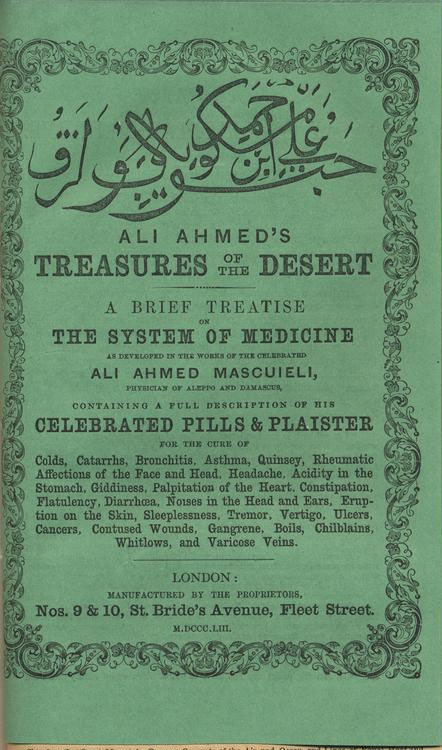
Ali Ahmed Mascueli was supposed to have been a Persian physician, who spent most of his life in Syria and developed the remedies using local herbs. On his deathbed, he confided the recipes to his relatives, who handed them down through the generations until, in the 19th century, they attracted the attention of  ‘an excellent and philanthropic Englishman’ who saw it as his duty to share them with the world. The pamphlet used a decorative border and examples of calligraphy (described by Bernard Darwin in his 1930 book The Dickens Advertiser as ‘lovely Arabic curly-wiggles’!) to lend an air of exoticism, emphasising the long tradition of eastern medicine from which the remedies had sprung.

Ali Ahmed Treasures of the Desert

Ali Ahmed’s Treasures of the Desert – cover of advertising insert. Image credit: http://www.ibiblio.org/dickens/html/42058.html

After a brief introduction, the pamphlet features a letter from a friend of the proprietor in Damascus, who had introduced the remedies there to the fury of the resident French and Italian doctors. The letter writer becomes a ‘character’ in the pamphlet’s narrative, entertaining the reader with a tale of a doctor so incompetent that he once ordered a large supply of sodium chloride, believing it to be a medicine.

In preference to such ‘scientific’ idiots, the letter-writer lauds ‘the simple native physician,’ whose drugs are ‘the kindest gifts of nature to suffering humanity.’ Unlike the violent substances such as strychnine and morphine prescribed by European doctors, the eastern practitioner’s drugs are ‘simple and pure; the mountainside furnishes him with herbs and roots, and the plains are bountiful in bulbs.’

The notions that a remedy stems from ancient, traditional knowledge, that it is safe and natural, and that narrow-minded orthodox doctors hate it are all, of course, to be found in dubious advertising today.

Punch pointed out that the medicines would probably work if taken as part of the lifestyle enjoyed by Ali Ahmed. Together with a sparse diet, only water to drink, and plenty of horseback exercise, they would no doubt remove ‘the worst congestion of the liver that ever affected alderman.’

So, just how exotic were these medicines? Cooley’s Cyclopaedia of Practical Receipts, Processes, and Collateral Information in the Arts, Manufactures, Professions and Trades, including Medicine, Pharmacy and Domestic Economy (Fourth Edition 1864) gave the ingredients as follows:

The Antiseptic Malagma comprised lead plaster, gum thus (frankincense or, more likely, thickened turpentine), salad oil and beeswax, spread onto calico. The Pectoral Pills were myrrh, squills, ipecacuanha, white soft soap, aniseed oil and treacle, while the Sphairopeptic Pills contained aloes, colocynth pulp, rhubarb, myrrh, scammony, ipecacuanha, cardamom seeds, soft soap, oil of juniper and treacle. The advertising also claims that the pills were ‘silver-gilt in the Oriental style’, a practice traditionally thought to have originated with tenth-century Persian physician Avicenna.

Ali Ahmed

Ali Ahmed, from an advertisement in vol. XV of Bleak House (May 1853) Image credit: http://www.ibiblio.org/dickens/html/42059.html

In celebration of the bicentenary year, The Quack Doctor plans some further posts tenuously related to Charles Dickens, so look out for them on the blog soon. In the meantime, happy 200th birthday, Mr. Dickens!


Categories: Chest Complaints, Digestive System, Wounds | 1 Comment

Anti-Stiff – strengthens the muscles


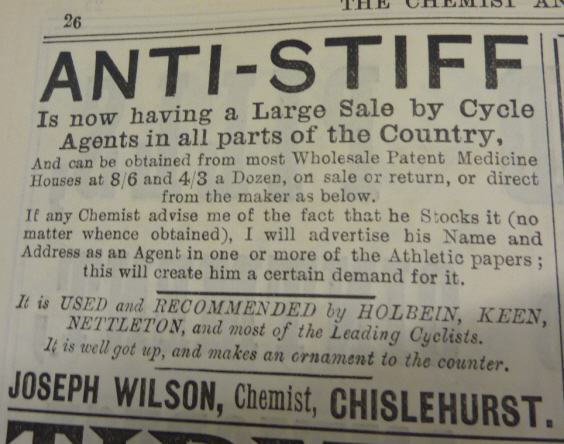
Anti-Stiff advert from The Chemist and Druggist, 7 June 1890

Anti-Stiff advert from The Chemist and Druggist, 7 June 1890

Anti-Stiff – a name contrary to the philosophy of today’s email spammers – appears to have been a boon to the athletes of the 1890s. It was a muscle rub intended to ward off aches and fatigue during a variety of sporting endeavours, and its promoter claimed that ‘some athletes are so fond of it that they rub it all over them.’

Unlike the messier liquid liniments that served a similar purpose, Anti-Stiff was a semi-solid substance packaged in a tin. U.S. publication the Western Druggist said that the product comprised petrolatum with some essential oils and colouring – so if you imagine a green, lavender-scented version of Vaseline, it was probably pretty much like that. Such a portable and convenient format made it particularly suitable for cyclists, who could carry it with them without the worry of dropping a glass bottle or spilling the product if they stopped to use it en route.

Adverts for Anti-Stiff regularly appeared in Cycling: An Illustrated Weekly, which began publication on 24 January 1891 and soon became a hit for its attractive layout, informative articles, humorous snippets and lively writing style. Right from the first issue, Anti-Stiff had a prominent advertising presence, asking readers:

Can you wonder that you lost that race?
Why, you did not use “Anti-Stiff!”

Testimonials abounded from the top cyclists of the day. C. A. Smith, who held the Brighton Coach Record (whereby cyclists would attempt to beat the times recorded by the old mail coaches between London and Brighton) said he was well rubbed down with Anti-Stiff before setting off on his ride. Cycling pioneer John Keen, who is mentioned in the ad above, also gave an endorsement, writing that he had used every other preparation known, but found none equal to Anti-Stiff.

John Keen

John Keen, champion racer of penny-farthings in the 1870 and 80s, who went on to manufacture bicycles. Anti-Stiff advertisements refer to him as 'The Champion Bicyclist of the World.'

Although initially aimed at cyclists, Anti-Stiff was for anyone who hoped to exhibit sporting prowess, including footballers, boxers, runners and skaters. Although Victorian footballers did not enjoy the same lifestyle as their 21st-century counterparts, they were nevertheless invited to view Anti-Stiff as one of the finer things in life:

An article of this kind is a real luxury, and when once it is tried by a footballer, he will always keep a tin of Anti-Stiff handy, and carry it about with him as valued as his watch.

Notts County coach Harry Kirk reported that his players considered it ‘grand stuff’.

Detail of Anti-stiff ad, Cycling: An Illustrated Weekly 11 April 1891

Detail of Anti-stiff ad, Cycling: An Illustrated Weekly 11 April 1891

Field athlete H. Griffin also recommended Anti-Stiff:

Personally, I can speak in very high terms of it. During 1890 I used it, notably for a stiffened shoulder through “putting the shot,” which it quickly put right “like a shot.”

I see what you did there, Mr Griffin.

The advert at the top is aimed at chemists. As you can see, the proprietor, Joseph Wilson, uses the incentive of free publicity for any chemist who stocks the product. He also appealed to those in the cycle sales and repair trade by offering to print their headed paper free of charge provided he could include a discreet advert. With marketing techniques so focused on what the customer could get out of the deal, it is no surprise that Anti-Stiff soon became well-known enough to get mentions in entertainment magazines such as Punch and Fun.

In May 1891, however, the latter publication didn’t give anyone much fun when it printed an Anti-Stiff joke so dire that it required a cringe-making Bruce Forsyth-style explanation of the punchline:

It should be sold in Turkey, for there there are millions of muscle men (Mussulmen.)


Categories: Musculoskeletal | Tags: , , , , | 1 Comment