Posts Tagged ‘1880s advertising’

The Mormon Elder’s Damiana Wafers – the most powerful invigorant ever produced

Sunday, December 4th, 2011

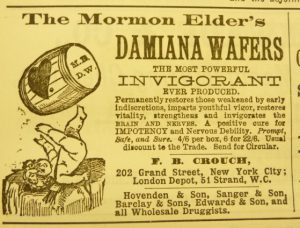
The Mormon Elder's Damiana Wafers

As a target of drug manufacturers, impotence has stood the test of time.

In the late 19th century, mail order remedies and relatively anonymous purchases from a chemist were ways of avoiding the embarrassment of visiting a doctor – and judging by the amount of spam devoted to the subject today, there is still a lucrative market.

Traditionally reputed as an aphrodisiac, damiana (the shrub Turnera diffusa) attracted the attention of the medical profession and commercial vendors in the US in the 1870s, but it was not always promoted as a cure for sexual problems. Fleckenstein and Meyer of Portland, Oregon, advertised it as a remedy for kidney and bladder disease, while Michel Levy & Co of Los Angeles promised in 1884 that ‘you will never have a sour stomach if you drink Damiana Bitters.’

New York druggist F. B. Crouch, however, was more explicit about the herb’s potential to restore vitality and youthful vigour to those suffering ‘nervous debility’. His brand capitalised on the perceived virility of Mormons, inviting the customer to wonder if this product was the secret to keeping up with all those wives.

The British advertisement above appeared in The Chemist and Druggist (16 Nov 1889), so it’s not aimed at the end user but at pharmacists who might stock the wafers. Discretion, however, was required.

In 1893, John James Blissett Hay of Wellington Street, Covent Garden, was summoned to Bow Street Police Court for exhibiting indecent advertising cards promoting damiana wafers in his shop window. The full product name is not mentioned, but the Mormon Elder brand trademark showed a naked woman – perhaps it was she who offended the sensibilities of a passing policeman. Because Hay took the advertisements down as soon as he was asked to, his fine was ‘only’ 20s.

The picture below was also used on advertising materials, making it clear that the wafers would increase your chances of some action. Bookseller Rick Grunder has a great colour version of this image from a pamphlet so rare that he sold it for $1,750.

Detail from Mormon Elder's Damiana Wafers trade circular

Detail from Mormon Elder's Damiana Wafers trade circular, courtesy of the NLM Images from the History of Medicine collection

A trade circular of 1888 described the product’s effect as follows:

Actually creates new Nervous Fluid and Brain Matter by supplying the Blood with VEGETABLE PHOSPHATES, its Electric Life Element, the very core and center of the Brain itself—Restoring the fullest and most Vigorous conditions of Robust Health of Body and Mind, so that all the Duties of Life may be pursued with Confidence and Pleasure, and whilst pleasant to the taste never fails to Purify and Enrich the Blood, and thoroughly invigorate the Brain, Nerves, and Muscles. Its energising effects are shown from the first day of its administration by a remarkable Increase of Nerve and Intellectual Power, with a Feeling of Courage, Strength and Comfort, to which the Patient has long been unaccustomed.

I don’t know the composition of the Mormon Elder’s Damiana Wafers, but other damiana products were not always what they seemed. In 1910, Henry Kaufman of New York was fined $100 for misbranding his Damiana Gin. The product contained strychine and brucine, but the extent of the misbranding was worse than that. Not only was the quantity of damiana negligible, but the product also had the unforgivable quality of not actually being gin.

Smith’s Live-Long Candy

Sunday, February 13th, 2011
Live-Long candy Nov 10 1888

From The Graphic, 10 Nov 1888

Sometimes, patent remedies killed people. The Live-Long Candy did manage to get mentioned at an inquest, and there’d be a particular irony in a product of this name carrying someone off – but I reckon it’s innocent.

Eight months before this ad appeared, 16-year-old Belinda Balls, housemaid to Mrs Waspe at Gusford Hall in Suffolk, was suffering abdominal pain. This was nothing new for her, but as she hadn’t been in her job very long, she tried not to make a fuss. On Saturday 24 March 1888, however, she was in such agony that she had to ask her fellow servants for help.

The cook, Jane Mallett, gave her a cup of ginger and Belinda struggled on with her work. By ten o’ clock that evening she was in serious trouble. Her mistress gave her some hot water, which made her vomit, and she went on to have a bad night, cared for by Mrs Mallett in their shared room.

On Sunday, Belinda took some ‘family pills’ (laxatives) to no avail, and had to stay in bed all day. That night, Jane Mallett sat up with her until she fell asleep, then helped her when she fell out of bed at four o’ clock in the morning.

When the cook next awakened at dawn, she was shocked to find her young companion dead.

Mr G H Hetherington, surgeon to the East Suffolk hospital, examined the body and found it to be ‘that of a woman well developed.’ Other than this observation, he could pass no comment until he had done a post mortem examination, when he discovered severe ulceration of the stomach. In his opinion, the cause of death was peritonitis. Mr Hetherington felt that Belinda’s habit of taking Live-Long Candy after meals had exacerbated her disease. Such quack remedies, he said, tended to alleviate the pain, but would cause constipation and ultimately be harmful. The implication was that the Live-Long Candy contained opium – but no analysis was carried out.

The Candy’s proprietor, J C Shenstone, at once wrote to the Essex Standard to set the record straight. The recipe had been around for 50 years, he said, since his predecessor Thomas Smith brought it to public attention and gained the endorsement of the Duke of Wellington. You might expect a dodgy practitioner to leap to an immediate and hysterical defence of his practices. Shenstone, however, defied any accusations of quackery by being completely reasonable and failing to threaten to sue anyone.

Shenstone was a dispensing chemist with premises on Colchester High Street. In around 1834, the shop had been established by Thomas Smith, who began selling the Live-Long or Digestive Candy a few years later. Certainly by 1844 he was doing a brisk trade in the stuff, and at around the same time employed an apprentice, James B. B. Shenstone, (a descendant of the 18th-century poet William Shenstone) who travelled all the way from Bath to take on the role. After his apprenticeship, Shenstone started his own business at Wells in Norfolk, but later returned to Colchester as junior partner to Smith. Thomas Smith died in 1864 and the business, including the Live-Long Candy recipe, went into the Shenstone family.

Henry Beasley, in The druggist’s general receipt book, gives the recipe as follows:

Powdered rhubarb, 60 grs.
Heavy magnesia 1oz.
Bicarbonate of soda 1dr.
Finely powdered ginger 20 grs.
Cinnamon powder 15 grs.
Powdered white sugar 2oz.
Mucilage of tragacanth q. s.
Beat together, and divide into parallelograms of 20grs. each,

The younger Shenstone’s letter was no-nonsense but polite. He offered a £200 reward to anyone who could prove that the product contained opiates or any other ingredient likely to cause constipation. He stated that he was ‘quite prepared to satisfy Dr. (sic) Hetherington privately as to the nature of all the ingredients used in the preparation,’ and included a note from the physician and surgeon of Essex and Colchester Hospital saying they had used the candy and found it beneficial. This could all have been done in an arsey passive-aggressive way, but in my opinion the tone of the letter is assertive but calm; an understandable response to someone who had made unfounded assumptions about the nature of the remedy.

Just a few months later, Mr Hetherington had more pressing matters to think about when his vehicle was overturned by a runaway horse – but perhaps that’s another story.

.

.

————————————————————————-

Medgadget AwardsThank you to everyone who has voted for The Quack Doctor as Best Literary Medical Weblog in the Medgadget Awards! If you haven’t voted yet and would like to, polls are open until 12 midnight (EST) on Sunday 13 Feb. For once in my life I would like not to be the wheezy unpopular kid trailing at the back, so if you can sling a vote my way I’d be very happy!

.

.

.

Gamjee’s Oriental Salve

Monday, July 5th, 2010

During the next couple of weeks I’m featuring some of the ads that have slipped through the net – either I can’t find out much about them, or I’ve already written about something similar.

The brief British season of thinking it might be nice to play tennis is now coming to an end. The crumbling tarmac of the courts on the local rec succumbs once more to weeds and the old wooden-framed school racket retreats to the back of the wardrobe.

This remaining enthusiast, however, has the advantage of tip-top health thanks to Gamjee’s Oriental Salve – which, in spite of its name, was mainly advertised in the Western Mail. The ‘white swelling’ referred to in the testimonial was tuberculosis of the joints.

Gamjee's Oriental Salve

GAMJEE’s ORIENTAL SALVE

(As supplied to the Right Hon, W. E. GLADSTONE)

CURES Burns, Sores, Piles, Rheumatism, Paralysis, Lumbago, Stiff Joints, White Swellings, Wens, Hip Disease, Chest and Lung Complaints, &c., &c.

ELIZABETH BLOOD, 28 Newthorpe-st., Nottingham. I suffered for over three years from white swelling. The doctor’s opinion here was that it would be years of ever I was cured. Whilst on a visit to Swansea I was advised to use Gamjee’s Salve. The change for the better was rapid, and in three weeks I walked up the steps of the Midland Station without assistance, although on my arrival I had to be carried. Four boxes completely cured me.—Certified by GEO. BLOOD, M.R.S.

Hundreds of similar cases have been cured.

GAMJEE’S EAST INDIAN PILLS, or Blood Cleansers, thoroughly Purify the Foulest Blood, Cure Indigestion, Bilious or Liver Complaints, Piles, Gravel, Wind, Restore Tone and Vigour to the most weakly constitution, and are the best in the world for all Female Irregularities. Perfectly Herbal and Tasteless.

Everyone who has tried them says they are the

BEST REMEDIES IN THE WORLD

In Boxes at 7½s., 1s 1½d., 2s.3d., 4s. 6d. From ALL CHEMISTS, or Free for the amount (with special instructions, if required) from the Manufacturer, CHAS. MAGGS, 13, Wind-street, Swansea.

Source: The Western Mail, 27 November 1885

………………………………………………..

W. E. Gladstone’s patronage of the product might or might not be true, but it foreshadows his portrayal as a political quack in this 1889 cartoon by Tom Merry. Gladstone as the charlatan is promoting the ‘Infallible Home Rule Ointment.’

The Travelling Quack

Courtesy of Wellcome Images

Professor Modevi’s Beard Generator

Saturday, July 3rd, 2010

While some historical quacks and their remedies remain famous, I often find adverts for products that have faded into obscurity. Some were one-hit wonders that only appeared in the papers for a few weeks, while others were well known in their time but don’t have much extant background information associated with them.

There are also ads I haven’t blogged about because they are too similar to those I’ve already covered. They are, however, worth sharing with the world, so over the next couple of weeks I’ll be featuring some of these gems rather than the usual more detailed posts.

First up is Professor Modevi’s Beard Generator, promoted in The Illustrated Police News on 4 April 1885.

Professor Modevi's Beard Generator

.

TWENTY YEARS’ SUCCESS.—The only really certain means of growing a beard hitherto discovered is the use of Professor Modevi’s

BEARD GENERATOR

Success guaranteed after four to six weeks’ use, even by young men not above seventeen years of age. Perfectly harmless for the skin. A 5s. bottle, or double-sized 8s. bottle, sent directly on receipt of P.O.O. or stamps for the amount. Only to be had genuine of GIOVANNI BORGHI, Manufacturer of Eau-de-Cologne and Perfumery, Cologne-on-the-Rhine, Germany.

Barrett’s Mandrake Embrocation

Tuesday, May 11th, 2010

Barrett's Mandrake Embrocation

BARRETT’S Mandrake EMBROCATION
CURES {HEADACHE! EARACHE! TOOTHACHE!} INSTANTLY.

Unequalled for Sprains, Bruises, Overstraining of the Muscles, Cramp, Rheumatism, Sciatica, Lumbago, Gout, Neuralgia, Chilblains, Bronchitis. To be had retail of all Chemists, 1s. 1½d., 2s. 9d., and 4s. 6d., postage 3d. extra ; or direct from the Sole Proprietor, JOSHUA BARRETT, 21, Beresford Road, Highbury New Park, London, N. London Wholesale Agents—Messrs. Newberry and Sons, Barclay and Sons, Limited, and all wholesale houses. SPECIAL NOTICE.—For the convenience of those at a distance from Chemists, J.B. Will send Three Bottles, post free, on receipt of 8s. 4½d., stamps or P.O.
To Mr. Joshua Barrett.—Dear Sir,—About twelve months ago, I, in playing football, had the misfortune to break a large muscle of my leg, which prevented my being able to walk, much more to play again. I may say that I have been under no less than three doctors, all of whom have failed to cure me. I was recommended by a fellow athlete to try your MANDRAKE EMBROCATION, and, I am pleased to say, with good result. I am now playing and running again as if nothing had happened. I shall have exceedingly great pleasure in recommending same to my numerous friends. If you like to make use of this, by all means do so.—Yours faithfully, H. G. THOMPSON, Captain, Kent Rovers Football Club, Kent County, and Sydenham Athletic Association.

Source: The Sportsman, 30 March 1889

——————————————————————————————-

Go to a country show, craft fair or exhibition, and chances are you’ll see at least one stall flogging health products that ‘can help with’ whatever happens to be wrong with you.

In the 1880s and 90s, Joshua Barrett used the same method to sell his Mandrake Embrocation and subsidiary products such as Mandrake Liver Powders and Mandrake Tonic. He also seems to have entered the Embrocation for the competitions prevalent at such shows, winning medals and diplomas of honour.

Barrett didn’t advertise much in newspapers, preferring to meet punters in person and give out handbills and free samples. This independence from the press meant that he didn’t need to be based in London, and in the 1890s he relocated to Snaith in Yorkshire – a sensible move bearing in mind he had previously travelled as far afield as Edinburgh to exhibit his product.

The advert above pre-dates the 1889-1890 Russian flu pandemic, and as you can see it makes no mention of influenza. Once outbreaks reached the UK, however, the Embrocation suddenly became ‘Scientifically Proved and Practically Demonstrated’ as a cure. The handbills explained why flu had never been mentioned before:

This remedy has only just been discovered, and the following directions are not with the Thousands of Bottles now in the hands of the appreciative public.

To ward off the early symptoms of flu, one had to

…take a piece of sponge the size of an egg, damp with the Embrocation, and hold it to the open mouth, inhale steadily, then close the mouth, swallow the fumes, and return them through the nostrils: repeat often.

Although an egg-sized piece of sponge was adequate, there was also a special inhaler available – a simple glass tube to hold an embrocation-soaked piece of wadding, and it was cheap at only a shilling. In the more advanced stages of influenza, Barrett also advised rubbing the oil on all achey parts of the body.

The most unusual thing about the Mandrake Embrocation is the absolutely terrifying trademarked logo. This grotesque coalition of man and anatid does not inspire much confidence in the product, but it is certainly eye-catching – and rather appropriate too, as the Russian flu pandemic was an avian strain originating in ducks. The man’s head is supposed to be a likeness of Joshua Barrett himself.

Mandrake logo

Bond’s Marvellous Corn Cure

Friday, January 8th, 2010

Bond's Corn Cure

Source: The Graphic, 19 Feb 1881

.

This is a product I really don’t know much about, but I just had to feature it on the site because I love the chap’s cheerfully unsympathetic response to his friend’s agony. And the agony of corns is not to be underestimated, judging by a case study from Thomas J Ashton in 1853. He reports on a maid-servant, aged 20, who had such a painful corn on her little toe that she cut it off.

Not the corn, the whole toe. Her method was to put a knife against the toe, like a chisel, and strike it hard with a mallet. The resulting haemorrhage occasioned some alarm to her mistress, who had her taken to hospital. She eventually recovered, but the healing was complicated by the fact that there was bone sticking out and, unlike with a normal amputation, no flap of skin left to cover the wound.

Bond’s Corn Cure was only advertised for a brief period in 1881, but was part of a long tradition of salves, plasters and unspecified wonder-cures that had appeared in the papers for more than 100 years. There was also a plethora of home remedies, but the usual advice from medical writers was to wear well-fitting shoes and use pads of linen or soft leather with a hole in them – much like the modern corn plasters.

Those crippled by pain, however, could get pretty desperate, and one option was to pay an itinerant corn-cutter to treat the offending area. Some of these practitioners were more skilled than others, and some were more honest than others. From the late 18th century, they were increasingly referred to as chiropodists, but the term met with a sneering response from the faculty, who saw it as a ludicrous attempt to make the occupation sound more scientific.

The paring of corns by a family member or by the patient themself carried a risk of drawing blood and causing septicaemia, but an additional risk with corn-cutters was that of being bled of large sums of cash.

An 1846 correspondent to the Lancet described how an earl of his acquaintance was fleeced by a chiropodist known to be preying on elderly wealthy customers. The earl, aged 78, had two troublesome corns and was willing to do anything to get rid of them – including agreeing to the corn-cutter’s demand of 10s. per corn.

The operation commenced; when it was over, the corn-cutter presented my friend with a paper on which were arranged 116 corns, or dark somethings which he designated such, and smilingly announced his claim of £58!

The earl paid up and, hugely embarrassed, didn’t admit the episode to his family for several weeks – whereupon they found it hilarious and told everyone, including the doctor who wrote in to the Lancet. His opinion on what he would have done in the same situation was: “I would have made the fellow eat up his corns, and then kicked him down stairs.”

But how was it physically possible for the chiropodist to extract 116 corns from the earl’s foot? Well, it was all part of a lucrative scam carried out by more than one disreputable corn-cutter of the time. At the beginning of the procedure, the chiropodist would smear a thick ointment over the foot. Within this were shavings from horses’ hooves, which could then be plucked out and displayed to the horrified patient. Some quacks used pieces of porcupine quill, according to the Lancet, but that seems to me a lot of trouble to go to when hoof-clippings were readily available.

With such dodgy practices going on, it’s no surprise that chiropody had a bad reputation, but there were ethical practitioners too, and by this time they were beginning to recognise the need for regulation. Lewis Durlacher, Surgeon-Chiropodist to the Queen, said of corn-cutters in the preface to his 1850 work, The Foot, its Pain and Penalties:

From such men the public, being unable of themselves to distinguish between the competent practitioner and the empiric, ought to be protected either by legislative enactments, or by medical bodies licensing those who make chiropody a part of their regular medical education.

In spite of Durlacher’s attempts, however, a professional body – The Society of Chiropodists – was not established in Britain until as late as 1912.

Dr Carter Moffat’s Ammoniaphone

Sunday, December 20th, 2009

Dr Carter Moffat's Ammoniaphone

Source: The Graphic, Sat 25 October 1884

The format of this one makes it a bit tricky to type out, but if you click on the advert, you should then be able to zoom in and read it. The Ammoniaphone was an instrument designed to help singers and public speakers improve the quality of their voice. It also claimed to cure consumption and other lung problems.

It consisted of a slender metal tube 25 inches in length, with decorated handles and a push-button valve on each end. As well as the picture below left, you can see a photo courtesy of the Science Museum, here. The instructions for use were as follows:

Unscrew the centre cap or nozzle two turns. Take hold of the Ammoniaphone, press the end valves, bend forward, place the lips tightly over the centre cap, and inhale very slowly but deeply.

Within the tube was a wick-like material soaked with hydrogen peroxide, ammonia and peppermint oil. The ingredients don’t sound very appealing, but the inventor, Dr R. Carter Moffat, described the vapour much more romantically as ‘Italianised Air.’

Italy was a destination for consumptives seeking a warm climate, but not only that – it also produced excellent tenors. While visiting the country, Carter Moffat (who was an eminent Scottish chemist, certainly no amateur enthusiast) had analysed the air and found the presence of free ammonia and peroxide of hydrogen – a combination he believed was unique to Italy and therefore likely to be responsible for the inhabitants’ operatic ability.

Shortly after its introduction, the rights to the Ammoniaphone were bought for £2000 in shares by the Medical Battery Company, run by Cornelius Bennett Harness. Dr Carter Moffat stayed closely involved, giving promotional lectures about his invention. The product was well-received by the press.

Not everyone, however, was convinced. In the Ladies’ Column of the Bristol Mercury (written ‘by one of themselves’), the correspondent described a musical evening where the Ammoniaphone was the object of much interest:

Several guests present took long whiffs from the ammoniaphone, but I discovered no obvious change in their tone or compass of voice. I suppose the experiment has to be frequently tried to produce any effect. I remarked that if the inhalation of free ammonia and peroxide of hydrogen is so good for the voice, it seemed scarcely necessary to enclose these ingredients in an expensive flute-like case to test their powers, and the fact of doing so and calling the vapour they give off “artificial Italian air” savours to me of quackery.

The manufacturers would have agreed that results only came from regular use. The instruction manual advised taking two inhalations a day and then doing vocal exercises – the voice would be ‘permanently improved in every way after one year’s use of the Ammoniaphone.’

The company’s promotional activities included commissioning an Ammoniaphone song – very apt, considering the target market. It told of the plight of a young man who wanted to propose to his sweetheart but lost his voice.

Ah! well for him and for the fair,
He’d heard that pure Italian air
Might be inhal’d, imparting tone,
Through Moffat’s famed “Ammoniaphone”

In the early 1890s a pocket version of the inhaler was introduced, but this was short-lived. The Medical Battery Company, whose main products were electro-magnetic belts, went bust in 1893 after getting into trouble with the courts for fraudulent claims. That, however, is a story for another post.

Albert's Grasshopper Ointment

Friday, August 7th, 2009

Grasshopper Ointment was registered in 1874 and the name was trademarked in 1884. It was still listed in Martindale’s Extra Pharmacopoeia in 1989, where the ingredients were given as rosin, yellow beeswax, larch oleoresin, arachis oil, white soft paraffin and copper acetate – but no grasshoppers. The copper would have given it a green tint appropriate to the name.

I have no idea why it was called grasshopper ointment but because it was also recommended for chilblains – and this is purely speculation – there could be a connection with the Provençal tradition of using praying mantises (known as tignos) as a chilblain remedy. You had to cut the mantis in half and rub the resulting juice onto the chilblain, whereupon absolutely nothing happened, according to J Henri Fabre in the The Life of the Grasshopper (1919).

There was also a widespread old practice of applying a live grasshopper or cricket to a wart in the hope that it would eat it off – in which case the ointment was probably a better bet.


OH MY LEG!

AH,   poor   sufferer!      Do  you  know  the  cause?   If  not,  I
will  tell you.   Your  leg  is  poisoned.   All  that   poulticing
and   fomenting   with  water  and  lotion  only  increases your
misery.  The  poison  must  be  extracted.   Send  at once  for
ALBERT’S GRASSHOPPER OINTMENT.   A  certain  cure
for bad legs and every known disease.
78, Farringdon-street, London, and all chemists, 1s. 1½d., 2s.,
2s. 9d.
Sir,—For  nearly  two  years  I  had  suffered  great  pain  from
a white swelling or housemaid’s knee, brought on by constant
kneeling   at   my  work  as  a  carriage cleaner  on  the  North
London Railway.
After  refusing  an  operation,  I  was cured by your Ointment
in five weeks.
………….R. JEFFERY, 63, Bridge-street, Canal-road, Bow.

Source: Reynolds’s Newspaper, Sunday 19 July 1885

The company also made Grasshopper Pills for headaches, insomnia, liver, kidney and digestive complaints. The picture below is kindly provided by Leo Reynolds, who took it at Niagara Apothecary Museum.

grasshopper pills

Radam's Microbe Killer

Tuesday, August 4th, 2009

Radam's Microbe KillerFamous for its trademark showing someone walloping the living crap out of a reanimated skeleton (if skeletons can be said to possess any living crap), Radam’s Microbe Killer was a fraud.

Its inventor, William Radam, published a book, Microbes and the Microbe Killer (189o) describing at great length his quest for a cure for his own rheumatism, which he believed to have been caused by microbes. A florist and nurseryman, Radam associated the killing of microbes in the human body with the killing of pests on plants. He sought to find a harmless antiseptic gas that would cleanse the human body just as fumigation destroyed the bugs in his greenhouses.

In the book, Radam is unspecific about the methods that led to his claimed success, saying vaguely “A little more improving, and I had the antiseptic that proved to be an antiseptic, without having experimented upon my body.” (p49, revised edition 1895) Analyses, however, showed that the remedy was more than 99% water, with traces of sulphuric acid, sulphurous acid and ash (Journal of the A.M.A., 1910)

For more in-depth information about Radam, his remedy, and the opposition he encountered, there are interesting articles at The North Texas Skeptic and Quackwatch.

.

Wm RADAM’S MICROBE KILLER

Nearly   all   well-read   people   are  familiar
with   the   scientific   investigations  of  Profs
Koch and Pasteur,  respectively  of  Germany
and   France,   as   well  as  a  number  of  other
scientists of almost equal renown, whose ex-
periments have proven conclusively that all
diseases are causes by microbes in the blood.
They are called microbes, because they are a
living   matter,   and  only  discovered  by  the
aid   of    powerful   microscopes.       But  until
William Radam discovered his Microbe Killer
Medicine    there   was   absolutely   nothing
known in the annals of  Medicine  that  would
destroy these Microbes or Germs of Diseases
existing   in   the   blood.   The  Microbe  Killer
does Kill the  Microbes  in  the  blood  without
fail, as the thousands of testimonials we have
in our possession demonstrate.
Microbes   being   the  cause  of  all  diseases,
Microbe  Killer will therefore cure  them.
WE EXCEPT NO DISEASES WHATEVER.
Ladies and  gentlemen  desiring  light  upon
the Microbe Theory, as well as upon any dis-
ease they may be afflicted with, are cordially
invited to call and get pamphlets for full  par-
ticulars. We will  forfeit  $1000  if  any  single
one  of   our  testimonials  can  be  proven  as
not genuine.
RADAM’S MICROBE KILLER CO.
For  sale  by  E.C.   FLEMING,  Druggist,  No.
South Detroit Street

Source: The Daily Gazette, Xenia, Ohio, 16 November 1889

Cigars de Joy

Saturday, May 16th, 2009

Charley's Aunt

 Unlike many of the remedies featured on this site, Cigars de Joy were popular with the medical profession, and were recommended in publications such as the London Medical Journal and the BMJ.          

According to the Medical Times and Gazette in 1875, the herbal cigarettes were ”very useful little agents for inhaling the smoke of stramonium.” Datura stramonium and its relative Datura tatula were common remedies for asthma, formerly being pipe-smoked before the “convenient” cigar form came along. Stramonium is hallucinogenic and an overdose can be fatal.

Image: W. S. Penley as Charley’s Aunt, by Alfred Bryan, 1893

.

                    CIGARS DE JOY
             ASTHMA, COUGH, BRONCHITIS
One of  these  Cigarettes  give  immediate  relief  in
the worst  attack  of  AsthmaCoughBronchitis,
Hay  Fever
,  and  Shortness  of  Breath.  Persons
who suffer at night with coughing, phlegm, and short
breath, find them invaluable, as they instantly  check
the spasm, promote sleep, and allow the  patient  to
pass a good night. Are perfectly harmless, and may
be smoked by ladies,  children,  and  most  delicate
patients. In Boxes of  35  Cigarettes,  2s.  6d.,  or  7
boxes 15s., post free, from  Wilcox & Co.,  and  all
Chemists.
CAUTION.—To guard against fraudulent imitations,
see that each box bears the name of “Wilcox & Co.,
239, Oxford Street, London.”

Source: The Ipswich Journal, Sat 8 May 1886