Posts Tagged ‘19th-century America’

Something to show and scare the people

Wednesday, August 25th, 2010

Tape Worm advertisement from 1895

TAPE WORM

Removed ALIVE IN TWO HOURS with HEAD or no charge. (No Fee in Advance.) No fasting. Have cured over 2,000 people of Tape worms with this harmless infallible specific, 50 per cent of which were doctoring for various other diseases, thereby eking out a miserable existence as thousands are doing. (Also cured two persons of LIZARDS.) Send stamp for circular.
Dr J. G. SHIPLEY
Montezuma, Iowa, Tape Worm Specialist of over twenty years’ experience.

Source: The Burlington Hawkeye, Iowa, 9 July 1895

………………………………………………………………………………

Tapeworm specialists advertised widely in late 19th-century American newspapers— Wait, what?… LIZARDS?

I wondered if ‘lizards’ was a colloquial term for some variety of parasite, but it seems Dr Shipley wasn’t the only one claiming to remove actual lizards from people’s innards. In 1900, Dr H D Rucker advertised that his medicine, ‘Korak Wonder’, had caused one Mrs E. J. Welker to expel a lizard ‘well formed and having four legs and feet.’

Tapeworm specialists had a variety of techniques and potions, but Charles Oleson, M.D, in Secret Nostrums and Systems of Medicine, describes a common method used by irregular practitioners. Oleson, though cataloguing the formulae of dodgy remedies, was not afraid to stand up for those he believed would work. This was one of which he heartily approved.

The patient must fast for a day, taking only a saline cathartic to empty the bowels. The next morning, he or she would take a teaspoon of the essential oil of male fern (whose Latin name, Dryopteris filix-mas, is one of the few things I remember from A-level biology) in a cup of warm milk. Milk was supposed to be ‘an article of food in which the tape-worm greatly delights.’

After this, the patient had to lie down for a few hours, keeping a slice of lemon handy in case of nausea, and then take a dose of castor oil, turpentine and croton oil – the latter being toxic and a rather drastic purgative. The spectacular effects of this mixture can be imagined. If you put a piece of mosquito netting over your chamber pot, ‘the worm itself can be easily retained for further examination,’ or for keeping as a pet or whatever.

Some tapeworm specialists did medicine shows in the street, and for this they needed to impress the punters by displaying preserved worms of enormous length. The Decatur Review (Illinois) in 1903 printed an anecdote about a worm doctor called Joe Bowen, who had given up a successful career as an auctioneer in order to go into the lucrative worm business. When he started out he did not have any specimens to display, and as the newspaper said:

If these tapeworm specialists haven’t something to show and scare the people, there is no use for them to set up.

Mr Bowen found an inventive solution:

He borrowed a crimping machine then he went to the slaughterhouse and gathered a lot of entrails. In a few hours after that, Joe had the finest exhibit of tapeworms that ever went on the street.

The exhibit did the trick and Bowen earned a fortune.

Less successful in the fight against tapeworms was an invention from earlier in the 19th century — Alpheus Myers’ Tapeworm Trap.

Alpheus Myers' Tapeworm Trap

This small metal capsule, about ¾ of an inch long and half an inch in diameter, was patented in 1854. It had a hole in one end and, inside, a sprung trap. The patient had to insert some bait – when making fun of the invention, newspaper reporters suggested cheese, but in fact the patent says any nutritious substance will do. The brave sufferer, having fasted for a couple of days to get the worm hungry, had to swallow the trap, keeping a string dangling out between their teeth. The peckish parasite was supposed to lunge for the bait and get its head stuck, after which all you had to do was pull the whole length of worm out through your mouth. It was important that the trap wasn’t too vicious:

… care should be taken that spring g, is only strong enough to hold the worm, and not strong enough to cause his head to be cut off.

The invention was about as effective and popular as you might expect – i.e. not very. Whether it would also work on lizards, I don’t know.

.

.

.

The Brinkerhoff System

Friday, January 22nd, 2010

The Brinkerhoff SystemTHE

Brinkerhoff System
—–OF—–
RECTAL MEDICATION!!

Piles, Fistulal Fissue [sic], Polypsus, Pru-
ritus, and Rectal Ulceration
Permanently and Pain-
lessly Cured.

Rectal Ulceration is the most dangerous of
all Rectal Maladies, owing to its undermining
the system before its victims realize their dan-
ger, this being due to the scarcity of nerves of
sensation in that portion of the rectum mostly
afflicted.
SYMPTOMS OF RECTAL ULCERS
Pain or weakness across lower portion of
back, often referred to kidney troubles, burn
ing in rectum, after, stool, itching about anus
attended with a moisture caused by discharge
from ulcer—constipation, sometimes being at
tended with spells of diarrhoea, finally result
ing in chronic diarrhoea when the case is a
lmost beyond cure, but if not too longstanding is
curable. Much and mattery discharges from the
rectum, soreness through the bowels extending
to stomach causing dyspepsia. In females fre-
quently vaginal and uterine inflammation and
ulceration. Make examination and consultation
free.
Write H. S. KISKADEN, M.D., 253 Wood-
ward Avenue, Detroit, Mich, for 58 page pamphlet
H.S. KISKADDEN, M.D.
Successor to
DRS. KISKADDEN and BRINKERHOFF, will be at
SANDUSKY CITY, West House, Thursday,
April 17, from 8 to 12a.m.
Fremont, Bail House, Thursday, April
17, from 2 to 5p.m.

Source: The Sandusky Daily Register (Sandusky, Ohio) 15 April 1890

………………………………………………………………..

There’s nothing unsurprising about the patentees of medicines or devices being out to make money, but Alexander W. Brinkenhoff was slightly different. His market wasn’t the end-user (as it were) but the people who would administer the treatment. For $200 plus a 10% royalty on fees earned from patients, anyone could buy ‘the Brinkerhoff System’ and set up as a travelling practitioner bringing relief to the suffering sphincters of the 19th-century U.S.

This was not a business opportunity for the squeamish. It didn’t involve selling the punter a useless medicine and then making a run for it before they found out it didn’t work. It was really hands-on stuff.

Although the ad above doesn’t focus on haemorrhoids, they were the System’s main target. The secret pile mixture – of which the franchisees had to buy new supplies when they ran out – comprised carbolic acid, olive oil and chloride of zinc. This wasn’t a soothing ointment for the sufferer to apply in privacy – the pile-doctor administered it by hypodermic needle direct to the seat of the problem. Quantities as follows (a U.S. minim = o.0616 ml):

Largest Piles………………………………………..8 minims
Medium “ ……………………………………..4 to 8 “
Small… “ …………………………………………2 to 3 “
Club-shaped painless piles near orifice….. 2 “

You would not have all your piles seen to at once. One at a time, or perhaps two, was quite enough, with the pile-doctor returning 2-4 weeks later to do the next one – by which time the first should have shrivelled up and fallen out. Brinkerhoff only recommended the injections for internal piles, because treating external ones this way would be far too painful. Some pile-doctors, however, got round this by injecting external piles with cocaine first.

When local pile-doctors advertised, they usually described the treatment as painless (or the less reassuring ‘nearly painless’), but Brinkerhoff’s instructions suggested that if agony did follow, hot sitz baths would be beneficial.

Reputable doctors also purchased the System for use in their practices, but some, like Illinois physician Dr Layton, soon realised they had got a bum deal:

As to its being painless, I can say from positive experience that this is far from being the case, as I have had several of my patients hint at a suit for malpractice on account of such excruciating pain and soreness; so that I even forgot to ask them for my bill.

The rectal ulcers referred to in the above ad required a different treatment – carbolic acid was still involved, but this time it was combined with ferric subsulphate solution, glycerine and witch-hazel. A genuine rectal ulcer was as unpleasant as it sounds, but luckily for the pile-doctors, they could diagnose normal anatomical features as ulcers, thus ensuring that everyone needed the treatment:

They [the itinerant doctors] generally show the patient’s friends the rectal fossa and term it a horrible eating ulcer, that is daily destroying the patient’s vitality, and which will sooner or later cause him to fill a consumptive’s grave.
The Medical Waif, quoted in C.W. Oleson, Secret Nostrums and Systems of Medicine

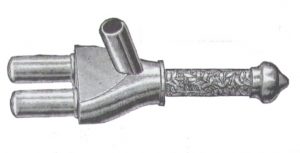
Apologies if this occasions you an image of all your extended family and neighbours clustering round to discover your hidden depths. They should be able to get a pretty good view, however, because the Brinkerhoff kit included a rectal speculum (pictured below). This invention was well-designed and well-made, and Brinkerhoff specula are still in use.

Brinkerhoff Speculum

Carbolic acid was already widely known as a treatment for rectal disorders and the Brinkerhoff System was no worse than other treatments of the time, which included the ‘clamp and cautery’ method. This involved drawing the pile out with forceps, clamping it and then snipping it off with scissors. The stump would be sealed with a cauterising iron ‘so applied as not merely to sear the cut surface, but to thoroughly “cook” the whole projecting stump well up to the clamp.’ As Edmund Andrews acknowledged in his highly informative Rectal and Anal Surgery (1889): ‘the idea of burning the parts with hot irons is horrifying to the imagination of the patient.

What was unusual about the Brinkerhoff System was the investment fee and royalties for the privilege of using a method that anyone could put together for a few dollars. Even more unusual is the idea that anyone would fancy this as their next career move.