Posts Tagged ‘mercury’

Pockey Warts, Buboes and Shankers

Wednesday, June 1st, 2011
The Daily Advertiser 5 August 1735

The Daily Advertiser 5 August 1735

As the old saying goes, ‘A night with Venus, a lifetime with Mercury,’ and Dr Newman’s Anti-Venereal Pills were just one of a plethora of clap and pox remedies advertised in 18th-century newspapers. The relatively anonymous purchase of a pea-sized bolus offered the customer a level of secrecy, but that was by no means the only reason for preferring an advertised remedy over consulting a doctor at home.

Notable physician and prolific writer Daniel Turner, in Syphilis. A practical dissertation on the venereal disease (1717) describes the standard treatment for the pox – salivation. Turner has a fluid style of writing that imparts elegance to even the most revolting of details, but the horror of the orthodox treatment shines through and sheds some light on the popularity of patent medicines.

In preparation for salivation, the patient should undergo purging medicines or bleeding and, for some, a warm bath was advisable. Women should have the treatment just after menstruation, and the temperate seasons of late spring and early autumn were the best time to carry it out – though of course it was not always possible to wait for the perfect time of year.

Turner recommends a dose of 15 grains of calomel twice a day. Initially the sufferer could expect violent diarrhoea and ‘horrid torture of the bowels,’ which in some cases would be quite sufficient to get rid of both disease and patient permanently, but after a few days came the initial signs of ptyalism – the copious production of saliva from which the treatment gets its name.

…we usually observe the Fauces to inflame, the Inside of their Cheeks to lie tumid, or high and thick, being ready to fall in betwixt the Teeth, upon shutting the Mouth; the Tongue looks white and foul, the Gums also stand out, the Breath stinks, (which is a good Omen of its coming on) and in general the whole Inside of the Mouth appears shining, seems as it were parboiled, lying in Furrows, much after the manner as it does in those who have lately held strong Spirits therein for the Tooth-ach.

By this point the patient wouldn’t be able to eat, but puking up phlegm was a good sign. While the unfortunate person was in this state, there wasn’t much the physician could do other than ‘to encourage your Patient chearfully to go on, and refresh him sometimes with a little mull’d wine.’

Turner’s experience suggested that at the high point (or low point) of the salivation, the patient could be producing up to five pints of saliva a day. This would subside and be resolved (one way or another) in about three weeks to a month.

All this, however, was just for a mild pox – a ‘stubborn and rebellious’ one would also require the patient to rub mercurial ointment into their limbs in front of the fire, and then wrap up in layers of flannel clothing. Along with the mercury, a salivating patient could expect aggressive treatment of the side effects – bleeding, emetics and laxatives were all part of the experience.

So this was the prospect if you consulted a doctor about the pox – not to mention the fact that your spouse and neighbours would find out what you had been up to.

A single, discreet dose from an advertiser seems not so much the preserve of the gullible as the self-preservation of the wary.

The Poor Man’s Friend

Friday, June 4th, 2010

The Poor Man's Friend

Source: Trewman’s Exeter Flying Post, 20 July 1826

In 2003, the Daily Mail ran a story titled: Beeswax is ‘miracle’ cure. The article referred to an 18th/19th-century ointment called The Poor Man’s Friend, a popular remedy for wounds and skin conditions. The reason it hit the 21st-century press was that its inventor’s original secret recipe had come up for auction.

Giles Laurence Roberts, proprietor of the Poor Man’s Friend, didn’t have a great start in life. Born in April 1766 in Bridport, Dorset, he contracted smallpox when he was nine months old. Although he recovered, he then got rickets and was unable to walk until the age of five.

Young Giles, however, pulled through, and by his early teens had developed a keen interest in medical botany, studying Culpeper and formulating his own herbal medicines. He achieved some local fame as a healer, particularly for cases of fever and ague, and was also fascinated by electricity, conducting experiments with a homemade electrical apparatus. Unable to make it work at first, he persevered and eventually managed to give himself an electric shock.

At 18, he went to work for a mechanic, but his master soon died and Roberts expressed a wish to become an apothecary’s apprentice. His family didn’t approve and he ended up in Bristol working for an optician. Sharing his lodgings was a respectable surgeon called Mr Pitt, who encouraged him in his interest in healing and anatomy.

Back home in 1788, Roberts set up shop as a druggist and, although unqualified, began practising as an apothecary. After six years’ successful business, he travelled to London to study Anatomy and Midwifery, attending lectures at Guy’s and St Thomas’s, and only a year later arrived back in Dorset as a fully licensed surgeon, apothecary and accoucheur. Only one thing was missing – the title ‘Doctor.’

King’s College Aberdeen awarded him a medical degree on 20 April 1797 – this appears to have been arranged by his tutors in London, and he did not have to do any further study or pass exams. Aberdeen was well-known for awarding medical qualifications on receipt of cash, so it’s possible that some money changed hands. Dr Roberts’s background of diligent study, however, made him far more deserving of his new title than many of the ‘Doctors’ featured on this site.

His successors describe his physical appearance as follows:

He was short in stature, being only about five feet high, dark complexion, a beautiful black eye, and in his younger days long black hair falling on his shoulders. In his dress, and appearance generally, he was singular and original, bearing mostly the character of a Quaker or Friend.

He began selling his own branded remedies at the end of the 1790s, starting with the Pilulae Antiscrophulae for scrophula and scorbutic eruptions. The Poor Man’s Friend remained a local product until about 1820 when it got an endorsement from an aristocratic patient and sales took off.

During the 1820s, Roberts began publishing a yearly pamphlet called the The annual mentor; or, Cottager’s companion: comprising concise maxims and golden rules for preserving the mind and body in health, and conducive to wealth, long life, and happiness, a Friend to the Poor, and a Companion for the Rich.

It’s no surprise that this free publication was mainly a plug for the Poor Man’s Friend and the Pilulae Antiscrophulae. At 32 pages, however, it contained a lot of other useful information. Short essays gave advice on health issues such as personal hygiene:

If dirty people cannot be removed as a common nuisance, they ought at least to be avoided as infectious. Superior cleanliness sooner attracts our regard than even finery itself, and often gains esteem where the other fails.

and there were lists of Wholesome Counsellings, including:

He that will not sail until all dangers are over, must never put to sea.
An ass was never cut out for a lap-dog
The wise man even when he holds his tongue says more than the fool when he speaks.
Marriage is a feast where the grace is sometimes better than the dinner.

There were also articles on choosing a wife, on the slovenly practice of burning green wood, on how to escape from a fire, and many more aspects of life. Although on the surface this all sounds tediously didactic, the information was presented in an engaging, accessible way that doesn’t come across as too worthy, and it beats Britain’s Got Commercial Breaks for an evening’s entertainment.

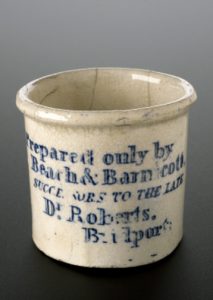
Poor Man's Friend dispensing potRoberts remained in Bridport for the rest of his life, dying in 1834. He left the recipes to Thomas Beach and John Barnicott, who took over the shop – the building is now Grade-II listed and houses a restaurant called Beach & Barnicott.

Roberts was in the middle of compiling the 1835 edition of the Annual Mentor when he died. Beach and Barnicott went ahead with publication, but in a shortened 24-page format. Later editions were reduced to 12 pages, most of which was adverts and testimonials. There were still a few general articles to draw the reader in, but the publication didn’t have the same entertainment value as when Roberts was alive.

The Poor Man’s Friend remained available until the mid-20th century, but made the news in 2003 when Bridport Museum bought the secret recipe for £480. Its composition, in the words of the Daily Mail, was ‘nothing more than 95% lard and beeswax’. Nothing, that is, except the other 5% - a fragrant but dangerous concoction of mercurous chloride, sugar of lead, mercuric oxide, zinc oxide, bismuth oxide, red pigments and oils of rose, bergamot and lavender.

Above right: Mid 19th-century dispensing pot. Photograph courtesy of the Science Museum, London.

The tragic story of Ching’s Worm Lozenges

Wednesday, March 17th, 2010


Ching's Worm Lozenges

The Hull Packet, 1 November 1803

..  

What is any self-respecting quack to do in the face of criticism?  

The answer in 1804 was exactly the same as it is now – turn nasty and threaten to sue the arse off everyone.  

The name ‘Ching’s Worm Lozenges’ might suggest that this will be an icky-parasite post, but in a way I wish it were. Instead, this story is incredibly sad.  

There were two kinds of lozenge – yellow and brown – that had to be taken at different times of day. Both contained white panacea of mercury. The travelling sales agents, however, were under strict instructions to assure customers that ‘not a single particle’ of mercury was in them.  

On 4 December 1803, a little boy called Thomas Clayton, aged 3, was given the Lozenges, followed three days later by a repeat dose. He went into a high state of salivation – one of the symptoms of mercury poisoning. His parents sent for medical help, but to no avail.  

.  

…the mouth ulcerated, the Teeth dropped out, the Hands contracted, and a Complaint was made, of a pricking Pain in them and the Feet, the Body became flushed and spotted, and at last Black, Convulsions succeeded, attended with a slight delirium; and a Mortification destroyed the Face, which proceeding to the Brain, put a period (after indescribable Torments) to the life of the little sufferer, on Sunday, the 1st instant, Twenty-Eight Days after he had taken the Poisonous Lozenges.  

The coroner’s verdict was ‘Poisoned by Ching’s Worm Lozenges’ and the above description is from a handbill written by the child’s father, also called Thomas Clayton. Clayton was a printer and bookseller, so was able to produce loads of these leaflets and personally deliver them all around his local neighbourhood in Kingston-upon-Hull. In them, he noted that the main Hull papers (the Packet and the Advertiser) had ignored both the death and the coroner’s verdict – probably because they received so much advertising revenue from Ching’s.  

John Ching himself had died in about 1800. The business was ostensibly carried on by his widow, but really came under the control of a dodgy cove called Mr Butler.  

Signing himself R. Ching, Butler responded with a broadside of his own, attacking the grieving father and threatening to prosecute him for publishing the case. He called Clayton’s words ‘malicious invective,’ ‘AN INFAMOUS ASSERTION and ABOMINABLE FALSEHOOD,’ and said he had ‘FLAGRANTLY LIBELLED TRUTH.’ These handbills were printed by Robert Peck of the Hull Packet – who, like many newspaper printers, was a vendor of patent remedies and was firmly on Butler’s side.  

I don’t know whether Clayton’s grief and campaigning activities led him to neglect his business or whether he was already in financial trouble, but he was declared bankrupt about a month after his son’s death. Although the newspapers hadn’t reported the poisoning, they were quick to advertise the sale of all the Claytons’ property. In a particular act of despicableness, Robert Peck allegedly turned up at the sale and boasted to Mrs Clayton that her husband would not get away with the libel.  

Clayton wanted to take the precaution of getting a written copy of the coroner’s verdict, but when he went to pick it up, he discovered that the coroner ‘had not time’ to do it. The Deputy Town Clerk was equally unhelpful, but it turned out that Butler was all talk and never went ahead with the prosecution.  

By 1805 Clayton must have managed to get back in business as a printer, because he published An Essay on Quackery, and the dreadful consequences arising from taking advertised medicines; with remarks on their Fatal Effects, with an account of a recent death occasioned by a Quack medicine. The author is anonymous and is usually assumed to be Thomas Clayton himself, but I believe it to be his brother, M. J. Clayton. The 140-page essay appears cobbled together, is understandably emotional, and it reproduces lots of excerpts from other writers, but it also offers a measured, sensible list of recommendations for stamping out quackery by replacing the government’s quack-related income with duties on other activities.  

This government revenue was substantial and goes a long way towards explaining why dangerous medicines were allowed to continue. Each bottle or packet had to carry a stamp – some quacks portrayed this as being a mark of official approval but, like most things in life, it was solely a way for the government to get money. I only have figures for 1839, but at that point the government was making approximately £49,300 per year from stamp duty, advertising duty, licences, patents and paper duty (for the wrappers that many remedies were sold in). It’s an awful lot of money, but the price paid by families like the Claytons was much greater.  

In a letter to the Medical Observer, the Essay author is exaggeratedly humble about his literary talents, but hints at attempts to suppress the book, and confesses himself chagrined at the lack of interest from the medical faculty. He also says that his own two children narrowly escaped the same fate as little Thomas, and so the Essay‘s chilling curse on Butler clearly comes from the heart:  

Dire conscience all thy guilty dreams affright,
With the most solemn horrors of the night.
The screams of infants ever fill thy ears,
And injured heav’n be deaf to all thy prayers.  

McAlister’s All-Healing Ointment

Thursday, February 18th, 2010

McAlister's All-Healing OintmentMcALISTER’S
ALL-HEALING OINTMENT
OR WORLDS SALVE

Has been an old family nurse for the past twenty years, and known all around the world as the most soothing and healing ointment in existence.
McALISTER’S ALL-HEALING OINTMENT
Never Fails to Cure.
Salt Rheum, Scrofula, Ulcers, Small Pox, Sore Nipples, Mercurial Sores, Erysipelas, Carbuncles, Corns, Bunions, and all Rheumatic Pains, &c. &c. Heals permanently Old Sores and Fresh Wounds. For Frosted Limbs, Burns, or Scalds. It has no equal in the World. Give it a trial.
Price 25 cents. Sold by all Druggists.

.

Source: Bangor Daily Whig and Courier (Maine) 6 March 1867

.

——————————————————

.

The aura surrounding the figure in this ad is not just for decoration. It represents insensible perspiration (sweat that evaporates before it can build up as moisture on the skin.) James McAlister believed insensible perspiration arose from the blood and drew off all impurities therein. Illness suppressed it, and life could not be sustained without it. ‘Stop up those pores,’ he said, ‘and DEATH knocks at your door.

The All-Healing Ointment, or World’s Salve, would promote perspiration and restore health – but that wasn’t all. As well as the list of conditions in the ad, it would cure consumption, cancer, worms, influenza, hernias and dog bites. It was an antidote to poison, would correct a tan or freckles and was even a hair restorer. Using a topical application made sense, McAlister argued, because throughout the Bible, medicine took the form of ointments and oils rather than being taken internally.

Here’s a male version of the image from the nostrum’s early days (1845):

Insensible Perspiration

The figure above is in rude health, with his insensible perspiration flowing freely around him – he is far more fortunate than the gentleman featured in an 1847 broadside. According to the text, the man had come to McAlister’s shop in South Street, New York City, in despair.

Scrofulous Man

Few men ever presented an appearance as appalling as his. His whole body from head to foot was covered with enormous

Tumors, Swellings and Ulcerous Sores,

from whence issued streams of purulent matter, making the entire surface

ONE MASS OF PUTREFACTION.

It seemed that nothing to be found had power to reach his case,

SO TERRIBLE! SO AWFUL! WERE THESE PUTRID SORES

He came into the store, and presented himself as one of the most pitiable objects, one of the most forlorn in expression of countenance of any man, I think, I had ever seen. The first words he uttered I shall never forget, coming as they did from the depths of the poor fellows heart,
“Oh! that I was dead!”

The melodrama continues, with the customer stripping off to reveal the extent of the putrefaction and detailing the failure of various sarsaparilla syrups, mercury and other medicines to help him. McAlister tells him the All-Healing Salve will save him; at this,

His whole frame shook like a leaf—his eyes shot forth unwonted fire, and every feature of his countenance was lit up with an unearthly expression.—Hope! Yes, Immortal hope, the last friend that forsakes us, dawned upon his soul, and he caught at the facts presented to him with the desperation of a drowning man.

After eight weeks’ use of the ointment, the man returns to the shop, smooth-skinned and exhibiting the greatest signs of health and happiness.

In April 1856 McAlister entered into an agreement with wholesale druggists Barnes & Park to supply them exclusively with the salve. Five years later, however, Barnes & Park realised that McAlister had been selling large quantities of the ointment to rival druggists, including A. D. Sands, (who also promoted sarsaparilla products like those that failed to cure our scrofulous friend above.) Barnes & Park sought an injunction restraining McAlister from selling the ointment to anyone else, but details of the case show that it wasn’t a clear-cut instance of an unscrupulous quack breaking his contract.

Barnes & Park had agreed to promote the salve but had not really bothered, and sales had diminished. In 1858 the company became sole agents for Redding & Co’s Russian Salve, which was effectively a rival to the All-Healing Ointment. If he had kept to the agreement, McAlister could have seen his product sink without trace. Justice Bonney, who oversaw the hearing, decided that both sides were as bad as each other, and dismissed the case with costs.

McAlister's All-Healing Ointment, or World's Salve

McAlister kept the ingredients a secret, but sometimes referred to the salve as ‘Vegetable’ (as in the print above), and claimed it ‘contains no Mercury’. I don’t know whether or not he was telling the truth, but I do know that in the language of 19th-century nostrum-vendors, these were common indicators that mercury was indeed present.

Swaim's Panacea – part 2

Sunday, November 8th, 2009

For part 1 about Swaim’s Panacea, click here.

Swaim's Panacea Hercules and Hydra

Woodcut commissioned by Swaim, showing Hercules battling the Hydra.

Within a few years of establishing his products, William Swaim was enjoying the benefits of endorsements from some of Philadelphia’s most eminent physicians, including Nathaniel Chapman, William Gibson, William Pott Dewees, Thomas Parke and James Mease – and he didn’t even have to make them up.

For the past ten years or so, sarsaparilla had been attracting renewed medical attention in the US as a blood purifier, so it was probably with this in mind that the doctors were well-disposed towards Swaim’s medicine. Swaim combined the sarsaparilla syrup with oil of wintergreen, giving it a pleasant taste that made it a hit with patients too. Gibson’s endorsement gives a further clue to its popularity:

I have always found it extremely efficacious, especially in secondary syphilis and mercurial disease. I have no hesitation in pronouncing it a medicine of inestimable value.

The symptoms of secondary syphilis, of course, disappear of their own accord before the disease goes into a latent phase – no wonder the Panacea and so many other treatments of the time claimed success.

In 1827 the New York Medical Society appointed a Committee on Quack Remedies, and the Philadelphia Medical Society soon did likewise. While the New York Committee acknowledged the possible benefits of the Panacea and other sarsaparilla-based syrups, the Philadelphia one was tougher, gathering numerous cases of people who had taken the medicine. The outcomes of these cases varied from no effect at all, to ‘a most violent and alarming bowel complaint’, to death. Analysis showed that the remedy contained corrosive sublimate (mercuric chloride).

Later, the New York Committee released its own analysis, done at the time of the investigation but not published, which showed that they too knew all along that it was mercury - so there, Philadelphia. A new analysis in 1831 also showed the presence of arsenic, but the ingredients varied from batch to batch and it was the luck of the draw whether you got the poisons.

By this time the doctors’ enthusiasm had waned. Chapman wrote:

Nathaniel Chapman

Nathaniel Chapman, pictured 1846

Early in the history of that article, I was induced to employ it, as well from professional as common report in favour of its efficacy, and was well pleased at the result in several cases. But! more extensive experience with it soon convinced me that I had overrated its value, and for a long period I have entirely ceased to prescribe it.

Gibson admitted that: In several cases that came under my notice, ptyalism has followed the use of it. (Excessive salivation, a symptom of mercury poisoning.) Their testimonials, however, were now out of their control and there was nothing they could do to stop Swaim continuing to use their names.

In 1836, long after the US physicians had backtracked on their endorsement of the nostrum, British journal The Medical-Chirurgical Review condemned them in true Tunbridge Wells style:

We were utterly astonished to find an impudent PANACEA bolstered up with the names and certificates of some of the first authorities, in the medical profession, of the United States!…

We are mortified and grieved, beyond measure, to find professional propriety (to give it no other name) at so low an ebb among our brethren in America! This admonition from Europe will surely rouse the faculty of the United States to some sense of the duty they owe to their brethren throughout the world.

The early success of Swaim’s Panacea inspired imitators to cash in with their own versions, and they were completely blatant about it. ‘Swayne’s Panacea’ hoped to dupe punters who weren’t paying attention, and ‘Shinn’s Panacea’ was sold with the statement: The subscriber having discovered the composition of Swaim’s celebrated Panacea, has now a supply on hand for sale.

One of the heavyweight rivals was Parker’s Renovating Vegetable Panacea, the ads of which contained fighting talk:

In justice to myself, I have been induced to reply to a false and unjustifiable attack made upon me and others by Swaim, the vender of a certain Panacea in this city.

I have been acquainted with the ORIGINAL RECIPE FROM WHICH SWAIM MANUFACTURES HIS MEDICINE FOR UPWARD OF TEN YEARS. IT WAS OBTAINED FROM MY FATHER-IN-LAW, WHO NOW RESIDES IN THE STATE OF NEW YORK, WHO HAS USED IT FOR THIRTY YEARS , AND PERFORMED INNUMERABLE EXTRAORDINARY CURES WITH IT.

Parker used his own version of the Hydra image, which, in a nice dig at Swaim’s battling Hercules, shows the mythical beast already defeated:

Parker's version of Hercules and the Hydra

Swaim’s reply tried to turn the copy-cat ads to his advantage:

This medicine had been used for seven years before an attempt was made to imitate it; but the great demand for it, and its wonderful success, have induced a great number of persons to imitate it in various ways—upwards of fifty different mixtures have been got up in imitation of it, which is a convincing proof of it being a medicine of great value.

Although the initial fame of the medicine declined, it continued to be made throughout the 19th and early 20th centuries, latterly with a different formula involving  alcohol and a huge amount of sugar.

Swaim's Panacea 1894 Galveston TX

1894 ad from the Galveston Daily News

Swaim's Panacea – part 1

Thursday, November 5th, 2009

Swaim's Panacea

SWAIM’S PANACEA.—This Medicine has acquired a very
extensive and established celebrity in Europe and America,
and its virtues are known and acknowledged by many of the most
respectable physicians of both countries. As an alterative, and
in various diseases, particularly in cases of inveterate corruption
of the blood descending to the second generation, it stands unri-
valled. Its safety and innocence have been fully tested, so that
it may be administered to the most tender and helpless infant.
No one, however, is advised to take it without being first con-
vinced of its efficacy and of the rectitude of the proprietor’s in-
tention. He has been induced to establish agencies in England
in consequence of the repeated and large orders for the Medicine
from various parts of the kingdom. He respectfully informs the
public that they can be supplied wholesale by EVANS, SON, and
CO., 85, Lord-street, Liverpool; EVANS and LESCHER, 4 Cripple-
gate-buildings, London; and retail by most of the respectable
Druggists in England, Ireland, and Scotland.

Source: The Liverpool Mercury, Friday 7 August 1847

.

If you’re Welsh, don’t be annoyed at being left out; count yourself lucky.

Although I’ve chosen a British ad here, the medicine’s home was Philadelphia, where William Swaim settled after a career as a bookbinder in New York. A probably apocryphal tale has him finding the panacea recipe scribbled on a blank leaf of a book he was binding; another story, related in James Harvey Young’s The Toadstool Millionaires, has Swaim finding out the ingredients from a reputable physician called Dr Quackinboss. Although this sounds made up, the name (but with the spelling Quackenboss), genuinely did belong to a New York doctor in the 1820s. (And for purposes of mild amusement, here is a modern example.)

Swaim’s advertising materials included booklets endorsing his nostrum, and the following unpleasant picture appeared in these and occasionally in his ads. You might recognise it if you saw the colour version recently displayed on the Ephemera Assemblyman blog. In this one, the bottle of Panacea is more prominent, and the facial expression more grotesque, but the depiction of the legs is thankfully less gruesome for the lack of colour.

Nancy Linton cured by Swaim's Panacea

Notice that the caption says ‘The representation and her actual appearance after having been Cured by the use of Swaims Panacea.’ I think they must mean ‘The representation of…’ but anyway, AFTER is the interesting word here. This image was supposed to encourage people to buy the medicine. Just think! Take this stuff and you too could spend the rest of your life hiding in a darkened room, tragically plastering your face with yet more mercurial preparations while the looking glass mocks you with the ghostly memory of the carefree beauty you were long, long ago.

The logic behind the use of this picture is difficult to grasp – any further theories welcome in the comments, but it could be:

1. In that state, Miss Linton should actually be dead, so the very fact that she’s sitting in a chair grinning is a testament to the miraculous power of the Panacea.

2. The horror of the image would exert a strange fascination on punters and compel them to read the promotional book. This is what happened to ‘Morleigh,’ the British writer of Life in the West, (1843):

‘…fronting the title page, we have a full-length portrait of a lady, or skeleton in a ball dress, grinning horribly. If this lady is cured, thought I, it would be very advisable for her to stay at home. Faugh! the very portrait has made me ill. I threw the book aside with scorn, little thinking that in a few days hence, when the book had mysteriously disappeared, I should earnestly seek a copy, and devour the contents with as much gusto as a starving sailor would munch an old shoe.’

.

To be continued…

In the next post – what was actually in Swaim’s Panacea, the proprietor’s on-off relationship with the medical profession, and how the Panacea’s success spawned blatant imitations.

.

Picture courtesy of the US National Library of Medicine

Empress Josephine Face Bleach

Monday, September 21st, 2009

Empress Josephine Face Bleach, Cream and Soap

In a testimonial included in another Empress Josephine Toilet Co. advert, “Mrs Jos. C. Morton” wrote:

Some years ago I ruined my skin and complexion by the use of worthless face powders. Pimples would raise up in large lumps all over my face. They oft times resembled more closely a boil than a pimple. Modesty and sensitiveness of my condition banished me entirely from my friends, and I also felt that my husband was really ashamed of me…

Fortunately for marital harmony, Mrs Morton grasped the “golden cord of hope” that was Empress Josephine Face Cream, and was entirely cured, making her shallow wastrel of a husband “more proud of [her] than ever.” (Newark Daily Advocate, Ohio, 5/7/1893)

.

BEAUTIFUL
WOMEN
OF PARIS

Have been using Empress Josephine Face Bleach, Cream and Soap for more than one hundred years to protect and preserve their pretty complexions. The
EMPRESS JOSEPHINE
FACE BLEACH
is positively guaranteed to be an effectual, pleasant and permanent cure for the following blemishes of the skin:
Freckles, Pimples, Moth Patches, Blotches, Extreme Redness, Eczema, Acne, Excessive Oiliness, Tan, Sallowness, Brown Spots, Blackheads and Roughness. Money refunded whenever it fails to do as represented.
CUT THIS OUT
———————–
DEAR MADAM. —This ticket
entitles you to a cake of
Empress Josephine Face
Soap free of charge, with
your first purchase of a
bottle of Empress Joseph-
ine Face Bleach.
JOHN F. COULSON, 804 Market St.
H.C. PURCELL, 821 Fourth St.
J. L. HANSON, 528 Broadway.

Source: The Logansport Journal, Indiana, 14 June 1893

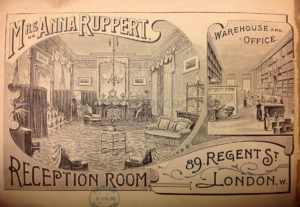
The Empress Josephine range was one of many cosmetic brands designed to give women that fashionable Victorian pallor. Others included Madame Ruppert’s Face Bleach, Mrs Graham’s Face Bleach, Malvina Cream and Lotion, the Royal Face Bleach and Hagan’s Magnolia Balm. A variety of dangerous ingredients formed the basis for such skin products, the main ones being lead carbonate, zinc oxide and corrosive sublimate (mercuric chloride). These could be absorbed through the skin, causing a wide variety of unpleasant physical, psychological and neurological  side-effects – for example,  death.

Harriet Hubbard Ayer, proprietor of unguents called the “Recamier Balm” and “Recamier Moth and Freckle Lotion” gave a recipe for face bleach in her Complete and Authentic Treatise on the Laws of Health and Beauty (1899). She suggested a solution of bichloride of mercury with glycerine, but in the quantities given it was luckily ‘not strong enough to blister the face in average cases.’ Good news for the average among us. Ayer helpfully warned:

Do not forget that bichloride of mercury is a powerful poison and should be kept out of reach of children and ignorant persons.

Which was all very well, but what if the ignorant persons were really tall?