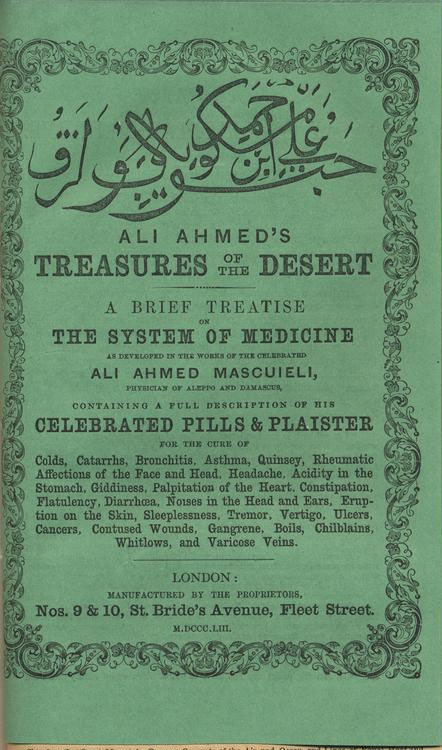

Poison. To be applied night and morning.

I have some wonderful pictures to share with you today thanks to collector Rex Barber from Perth, Western Australia, who owns several hundred 18th – 20th century proprietary remedy lids. Rex has exhibited his collection as far afield as the Federation of Historical Bottle Collectors’ 2012 show in Reno, NV.

Grimstone's Eye Snuff

Many lid designs not only detail the remedies’ names and vendors, but also the claims made for the contents. Some of the products, Rex says, were manufactured by proven charlatans, while others were more homespun – perhaps sold to a local clientele by a blacksmith possessing a family recipe.

Most of the designs are examples of underglaze transfer, a printing process pioneered by Staffordshire manufacturers – including Josiah Spode – in the second half of the 18th century. By the beginning of the Victorian era this process, which involves printing an engraved image onto thin paper and then transferring it to the ceramic surface, had become extremely popular. Polychrome printing by this method was associated with the Pratt factory in Fenton from the 1840s onwards, but some of the colour pieces in Rex’s collection possibly pre-date the advent of transfer-printed Prattware.

In the mid-1990s, I lived for a while near Stoke-on-Trent, where the names of Spode and Wedgwood were almost as familiar to me as KwikSave No Frills Instant Mash and the bloke on the corner proclaiming ‘Five for a pound lighters!’ I never studied the ceramics industry in any depth, however, so it’s exciting to be discovering more about it from someone on the other side of the world!

Below is a selection of the pictures that Rex kindly gave me permission to reproduce, and I have some more to share with you in another post. The lids range in diameter from 20mm to 105mm, with the occasional square or oblong one, although these are rare. 

The one for Hancock’s Bath Curative shows a typical base that would contain the remedy. Some products claimed to treat wide-ranging lists of conditions –  Measam’s Medicated Cream, for example, not only promises to deal with ringworm and corns, but is also suitable for cleaning the teeth. You’d probably want to check exactly how the rest of the family were using it before you applied it to your toothbrush.

This slideshow requires JavaScript.


Categories: Feet, General Health & Panaceas, Musculoskeletal, Scurvy, Skin, Teeth, Wounds | Tags: , , , , , , | 1 Comment

‘Come for the skin book, stay for the history!’ An interview with Dr Lindsey Fitzharris

The image of the 18th-century anatomist is a shady one, redolent of midnight forays into graveyards and dissection in front of a rabble of students. The cadavers in these scenes are anonymous and devoid of character; mere objects fuelling a relentless craving for knowledge.

Lindsey Fitzharris during filming for Medicine's Dark Secrets

But everybody who ended up on the anatomist’s table was once a person meeting the everyday worries and joys of life. Dr Lindsey Fitzharris, writer of The Chirurgeon’s Apprentice blog, is exploring the reality behind the people whose bodies helped advance the science of surgery. She is crowdfunding her TV documentary, Medicine’s Dark Secrets – and what a fascinating programme it promises to be! I asked Lindsey to tell me more about herself and her project.

The Quack Doctor: Medicine’s Dark Secrets is an intriguing title with hundreds of possibilities! What will the programme focus on?

Lindsey Fitzharris: At its core, we want to explore the development of early modern surgery by telling the stories of the people who died and the surgeons who cut up their dead bodies in the 18th and 19th centuries. Our medical heritage can be dark and macabre, but it’s important to acknowledge what went on in the past, and how it contributed to our understanding of human anatomy.

Why did you decide to fund it through IndieGoGo?

We interact with death in very different ways than people did in the past. Some of the objects I’ll be looking at in Medicine’s Dark Secrets may shock viewers, like the book made of human skin or the dissected hands of a man who committed suicide in the 19th century.

What I hope to provide through this documentary is historical context. Most importantly, I want viewers to remember that these disembodied specimens once belonged to real people with lives like you and me. By raising the money through IndieGoGo, I’ll maintain control over the project so that it doesn’t just become a voyeuristic journey into the past.

The response has been amazing, with thousands of dollars raised! Why do you think Medicine’s Dark Secrets has captured people’s imagination in such an exciting way?

I think it’s very natural to be curious about death. We live in a ‘death-starved’ culture, and this only intensifies our curiosity about such things. Beyond that, people want to know more about their past, and medical history is not a subject which is normally explored in documentaries. This show will unite the visual with the contextual; and give viewers access to collections they would not otherwise be able to see.

I don’t believe the past belongs only to historians and scholars. It should be open for all to experience. I think that message resonates with people, and that’s why there has been so much support for this project.

I know you’ve already had experience of presenting in front of the cameras. What is the most fun thing about it? And the worst?

For me, the best part is getting an opportunity to meet interesting people in equally fascinating locations. For the trailer, I interviewed a bio-archaeologist in the crypt of St Bride’s Church; spoke to a tattooist about preserved skin specimens in St Bart’s Pathology Museum (below); and even interviewed the Coroner of Westminster at Ben Franklin’s house.

The worst part is the repetition. People don’t realise how long it takes to film a very short segment. On average, it takes 3-4 hours to get 5-10 minutes on film as the scene needs to be shot from various angles with different cameras and lenses. A lot of this involves repeating myself over and over again until we get it just right. It can be tedious!

St Bart's Pathology Museum

From your activity on Facebook, Twitter and your blog, you come across as a confident, supremely intelligent woman (not to mention beautiful, says The Quack Doctor, trying not to turn green). Do you ever have doubts and insecurities?

That’s so kind of you. But believe-it-or-not, I’m a ball of insecurities! When I was growing up, I was an awkward child. I was 5’7’’ by the age of 10 and struggled with my weight for most of my life. Seeing and hearing myself on camera is difficult as I still feel like ‘that girl’ who used to outsize the boys by a half a foot!

What’s your favourite early modern surgical instrument?

I’d have to say the scarificator. Not only does it sound like something out of a horror film, but it is also one of the more common instruments used to bleed patients from the 18th century onwards. It typically had 14 blades hidden beneath its lower surface. When placed against the skin, and released by the trigger, these metal blades emerged and slashed rapidly into the patient’s skin. There were few pleasantries about living during this period!

If you’d been born in the year 1700, how long do you think you would have survived?

Not long at all! I was a very sick child, and had several bouts with pneumonia growing up. I imagine I would have died young and been mourned briefly.

You’ve been described as a ‘Deathexpert’. What would you like to happen to your body after your death?

I think what we imagine our funeral to be at the age of 30 is very different from what we imagine our funeral to be at the age of 75. If I dropped dead today, I’d want my body handed over to my friend, Jeff Jorgenson, who runs a innovative company in Seattle called Elemental Cremation and Burial. He tries to offset the polluting effects of body disposal and comes up with interesting ways to memorialize the dead. I’ve not given much thought to this – but I’d love for him to use my death as a promotional gimmick to get people talking more openly about these important issues.

If I live to 75, ask me this question again.

I hear you collect medical trade cards. Do you have a favourite item in your collection?

If I had to choose, I’d say the 19th-century business card for a hypnotist which reads: ‘cures without medicines!’

Hypnotism trade card

Academia’s relationship with popular history can be rather tense. Given your strong academic background, what sort of attitudes have you encountered when others in the discipline hear about your blog and TV project?

I’m not going to lie. Not everyone agrees with what I’m doing. Some people think I am ‘bastardizing’ the discipline. Others think I’m being purposefully sensational. And while there is no doubt that I hit upon sensitive subjects in both my blog, as well as on the show, I hope that people come away with a real understanding of the history behind these objects when they leave. I like to say: ‘Come for the skin book, stay for the history!’

That said, I cannot tell you how much support I’ve received from friends and family over the years. People like Jillian Drujon, Alex Anstey, Brandy Schillace and Shannon Marie Harmon have kept me going throughout this project, as has my father, Michael Fitzharris, who encouraged me to keep writing even when I felt no one was listening.

Which two individuals – practitioners or patients – from the history of medicine would you like to invite to dinner?

The 18th-century anatomist, John Hunter and the Irish Giant, Charles Byrne.

Byrne knew Hunter wanted his body when he died, and requested that his friends bury him at sea to prevent bodysnatchers from stealing his corpse and selling it to the eager anatomist. Unfortunately for Byrne, his friends were easily bribed. Hunter bought Byrne’s body for an extraordinary £500 in 1783; and poor Byrne’s skeleton now resides in the Hunterian Museum at the Royal College of Surgeons in London.

I imagine dinner would be tense but fascinating!

How can people get involved with Medicine’s Dark Secrets?

People can donate to the campaign through IndieGoGo. We are offering some fun premiums, including a chance to have tea and syphilis cupcakes with me and the curator of St Bart’s Pathology Museum! As ever, I appreciate everyone’s support – no matter how large or small.

Thank you, Lindsey, for taking the time to answer my questions, and I’m really looking forward to seeing Medicine’s Dark Secrets on screen!

Categories: Other things of interest | Tags: , , , , , | 1 Comment

A barbarous, insanitary custom

I dread to think what moral bacteria are lurking in that moustache

CRUSADE AGAINST KISSING

New York Lady Doctor says it is Barbarous.

Great amusement has been caused in New York by a crusade against kissing started by the local branch of the Women’s Christian Temperance Union.

Dr. Anna Hatfield, lady physician, the leader of the new movement, in the course of an interview, said that kissing is a barbarous, insanitary custom, worse than drinking, and should be rigidly abolished. No person should kiss another without first using an antiseptic wash on the mouth to destroy bacteria.

‘As for the moral bacteria,’ she said, ‘that is even more dangerous. Girls are not taught to view a kiss with awe, as they once were. Engaged persons should be allowed only one kiss at the time of betrothal. Mothers of to-day are to blame for imbuing their children with the kissing vice. Many children are literally kissed to death.

‘Kissing between women is quite as unwholesome. It is time to make war on kissing and I am willing to go on record as firing the first gun.’

The progress of the anti-kissing crusade is being watched with great interest, but its failure is generally predicted.


Source: The Northants Evening Telegraph, 29 December 1900

Categories: Love & Marriage, Strange reports | Tags: , , , , | 1 Comment

The most uncanny look

 IRRESISTIBLE EYES

MAY BE HAD BY TRANSPLANTING THE HAIR.

If your eyes are unattractive you may make them irresistible by transplanting the hair. Transplanted eyelashes and eyebrows are the latest things in the way of personal adornment.

There are specialists who make a handsome living out of the process of transplanting hair from the head to the eyebrows or eyelashes. The specialist works by putting in, not on, the new eyelashes and brows wherever they are absent or grow thin, and so cunning is he in his work that not even the closest scrutiny can detect any difference.

By means of the new process, it is said, eyes which are at ordinary times only passable become languishing in their expression, while eyes which were previously considered fine have their beauty much enhanced.

This is the way new eyelashes are put in:–

An ordinary fine needle is threaded with a long hair, generally taken from the head of the person to be operated upon. The lower border of the eyelid is then thoroughly cleaned, and in order that the process may be as painless as possible rubbed with a solution of cocaine. The operator then by a few skilful touches runs his needle through the extreme edges of the eyelid between the epidermis and the lower border of the cartilage of the tragus. The needle passes in and out along the edge of the lid leaving its hair thread in loops of carefully graduated length.

When this has been done another length of hair is sewed through the lid until finally there are a dozen or more loops projecting. By this time the effect of the cocaine has been lost, and the operator is obliged to desist, and put off further “sewing of hair” for another sitting.

The next step in the process is cutting off and trimming the ends of the loops, and the result is a fine, thick, long set of eyelashes. It is the finishing touch, that is to come, that makes them look like nature’s own. When they are at first cut they stick out in the most singular fashion, giving the person operated upon the most uncanny look. The operator’s next step is to take curling tongs, made of silver, and no larger than knitting needles, and to give them the curve which is essential to perfect beauty. Then the eyes are carefully bandaged, and kept so until the following day.

Most of the hairs that have been transplanted take root and grow, but a few of them fall out, and have to be attended to. For the first month it is necessary to curl the new eyelashes every day, but after that they become properly assimilated, and it is not necessary to give them any further attention.

Eyebrows are doctored in the same way, but there is not so much pain associated with the process as there is in transplanting eyelashes.

The Dundee Courier, 6 July 1899

—————————————————————————-


In the 21st century, eyelash transplants have resurfaced as a beauty procedure, but even at the time of this excerpt, the supposed fad had been around for almost two decades, if not longer.

Tales of eyelash transplants in Britain seem to have been spawned by an 1882 news snippet by Henry Labouchere in Truth, which referred to the popularity of this procedure among Parisian beauties. Well into the 20th century, the story kept popping up as a curious example of the ‘worship of beauty’ and the pain women’s vanity would induce them to endure. The stories, however, contained no reference to identifiable practitioners, or any individual accounts of undergoing the operation. I would love to find an advert for a Victorian beauty doctor offering this service – I’d better keep my passable eyes open and will report back if anything turns up!


Categories: Cosmetics, Eyes | Tags: , , , , , , , | Leave a comment

Compliments of the Season

Beetham's Glycerine and Cucumber


The Quack Doctor wishes you a happy Christmas and the best of health in 2013!

Categories: Cosmetics, Site stuff | Tags: , , | Leave a comment

‘Set the spirit alight’: Victorian festive science

Ah, Christmas! A time for peace, goodwill, and setting fire to chemicals.

I was intrigued the other day by Rupert Cole’s article at the Guardian about the crossover between the cultures of science and Christmas during the Victorian period, so I’ve unearthed some festive scientific amusements recommended by 19th-century newspapers.

How heartwarming it is to see the time and trouble people will go to in order to give their loved ones a Christmas full of wonder, laughter, and hospitalisation. Don’t try these at home. (Or, if you do, I take no responsibility for the inevitable consequences.)


———————————-

THE FIERY MASK

Into a bottle containing one ounce of sweet oil, put a drachm of phosphorus; let it stand a few days, and it will be fit for use. If a sponge dipped into this liquid be passed lightly over the face, it will present an awful appearance in the dark. This is a harmless experiment if used carefully, and will not fail to create a great deal of merriment. This preparation is also called the “Luminous Bottle.” If the stopper be removed, it emits a light sufficient to discern the figures on a watch.

———————————-

BREATHING FLAME

One of the most ancient feats of magic, was to breathe a flame; a feat now looked upon by many as a miracle. This feat is performed more simply by the modern magician, thus: having rolled together some flax or hemp, so as to form a ball the size of a walnut, he sets it on fire, and allows it to burn until it is nearly consumed; he then rolls around it some additional flax, and by these means, the fire may be retained in it for some considerable time. At the beginning of his exhibition, he introduces the ball into his mouth, and while he breathes through it the fire is revived, and a number of sparks projected from his mouth, which do no material injury.

———————————-

TO BLOW AN EGG FROM ONE WINEGLASS TO ANOTHER

Place an egg in a wineglass, the thicker end downwards. Then put an empty wineglass immediately in front of the other glass. The trick is to blow the egg from the one glass into the other. It is easily done, at least after a little practice.

The lips should be placed close to the rim of the glass containing the egg. Then the experimenter should blow strongly and sharply, directing the air, as far as possible, between the egg and the side of the glass. The egg, if the experiment is well done, will jump out of one glass into the other.

It is wise to use a hard-boiled egg for this experiment. 

———————————-

A SELF-PEELING BANANA

When dessert is served, much interest can be excited by the following simple trick. Challenge your friends to peel a banana without touching it. Naturally, they will consider such a feat impossible, and you will then proceed to show them how easy it is. Procure a bottle with a neck about the thickness of a banana, and drop into it some alcoholic spirit. Set the spirit alight, and, while it is burning, place in the neck of the bottle the smaller end of a banana, on which you have secretly made four longitudinal incisions. To the utter amazement of the company, the banana will gradually disappear into the bottle, shedding its skin as the invisible force drags it down. The trick is performed by purely natural means. The fire in the bottle produces a partial vacuum, and the outside atmosphere presses the fruit into the empty space.

 ———————————-

FIERY FOUNTAIN

If twenty grains of phosphorus, cut very small, and mixed with forty grains of powdered zinc, be put into half an ounce of water, and two drachms of concentrated sulphuric acid be added thereto, bubbles of inflamed phosphorated hydrogen gas will quickly cover the whole surface of the fluid in succession, forming a complete fountain of fire.

———————————-

EXPERIMENT WITH A PIPE

Compose a powder with one ounce of saltpetre, one ounce of cream of tartar, and one ounce of sulphur, pulverised singly, then mixed. Put a single grain of this powder into a tobacco-pipe, and when it takes fire, it will produce a very loud report without breaking the pipe.

 ———————————-

THE EXPLODING BUBBLE

If you take up a small quantity of melted glass with a tube (the bowl of a common tobacco-pipe will do), and let a drop fall into a vessel of water, it will chill and condense with a fine spiral tail, which being broken, the whole substance will burst with a loud explosion, with injury either to the party that holds it, or him that breaks it; but if the thick end be struck, even with a hammer, it will not break.

———————————-

THE WONDERFUL BOTTLE THAT POURS FORTH ALTERNATELY WINE AND FIRE

Get a tinsmith to make you a trick bottle, that is, a double bottle, or bottle containing a smaller bottle inside. The outer compartment must be made to contain wine or any other liquor; in the inner compartment there must be a hole from the neck to the bottom of the bottle. Procure a table in which is a hole of exactly the same size as the one in the bottle. Show the bottle to the assembled company, and offer them some wine; pour it out, and then place the bottle over the hole in the table. Your confederate, who is concealed under the table, then thrusts a squib through the hole in the table into the bottle. You set fire to it, apparently accidentally, and as soon as the fire has ceased to shower, and while it is yet smoking, take up the bottle again and pour out more wine. Well executed, this is one of the best tricks ever invented.

 ———————————-

Sources:

‘A Budget of Christmas Tricks,’ The Kentish Gazette, Tuesday 24 December 1861

‘Scientific Amusement for Christmas.’ The Chelmsford Chronicle, Friday 26 December 1851

‘Some Amusing Experiments for Christmas Parties.’ The Manchester Times, Friday 18 December 1891

‘Christmas Science.’ The Northampton Mercury, Friday 20 December 1895


Categories: Other things of interest | Tags: , , , , , | 1 Comment

Lazy salesmen and popular bachelors

1910, Traveling salesman on a trainThe life of a travelling salesman in the early 20th century US might have involved stuffy railway carriages, soulless hotels and rejection by jaded druggists, but that doesn’t mean there were no lighter moments.

The reports of the Illinois Pharmaceutical Travelers’ Association, established in 1903, give a delightful glimpse into the fun and games to be had at its annual meeting – where the bureaucratic essentials found their balance in such unmissable events as the Fat Man’s Race and the Single vs Married Ladies Tug-of-War.

The Travelers formed an auxiliary organisation of the Illinois Pharmaceutical Association, intended to bring commercial salespeople under the IPA’s aegis and to increase its membership by ‘selling’ the advantages to the druggists they visited. An even more important part of the Travelers’ remit, however, was to arrange the entertainment at the yearly summer convention, where druggists and salesmen could network with each other and engage in friendly rivalry.

The convention had its official purpose, of course, but once the AGM was out of the way, it was time for sightseeing, dining, smoking and enjoying the all the vibrancy and humour the patent medicine trade had to offer. As well as excursions to local places of interest and card parties for the delegates’ female companions, the highlight of the convention was Gala Day.

In the first year of the Travelers’ existence, 1903, they did the Association proud with a programme of amusements at Miller Park, Bloomington, IL. Attendees could compete for valuable prizes in contests that must have been a hoot to behold, especially after a hearty picnic in the sunshine and more than a few swigs from a hip flask. As most of the prizes were donated by the manufacturers of commercial pharmaceuticals, the winners could find themselves in possession of such covetables as Tanglefoot Fly Papers or a case of Dr Kilmer’s Swamp Root.

Some of the competitions called upon talents specific to the trade – in 1904, for example, Fred Thayer won the Deciphering Prescriptions contest, receiving a case of Alabastine (a wall coating that ‘destroys disease germs and vermin’). Other competitors showed their expertise at ‘Guessing the Weight of Mercury’ and ‘Identifying Crude Drugs’.

There was, however, plenty for the attendees’ families to get involved with too. Anyone could take a guess at how many ‘Iron-up’ tablets were in a jar, and numerous events were reserved for ladies – including the Nail-Driving Contest and the Chewing Gum Contest.

Not a dull moment was spent during the entire afternoon,’ said the 1904 report.

Other competitions required athletic prowess. To be eligible for the Fat Man’s Race, contestants had to weigh at least 190lb, though by 1908 the threshold had risen to 210lbs. Lest thin folks felt left out, there was also a ‘Lean Man’s Race’ for those under 140lb. Average-weight people had plenty of opportunity to join in the fun with events such as the sack race, the 100-yard dash and ‘The Longest and Loudest Shouter.’

The amount of organisation involved was considerable. In 1905, the Travelers arranged for the S.S. Charles H Hackley to take guests from Rush Street Bridge to Fort Sheridan. There, they would watch artillery, cavalry and infantry drills, then ride the Chicago and Milwaukee Electric Railway to Ravinia Park, ‘the most beautiful and artistic summer resort in America,’ for ‘lunch under the beautiful trees and field events accompanied by Sousa’s Famous Band.’

It was August. The weather should have been wonderful, but the 800 attendees got off the boat at Fort Sheridan to face a mile walk in the pouring rain, lunch under cover, and the athletic events called off. Nevertheless, they managed to enjoy the music in the band pavilion and ‘everybody was wet, but good natured.’

Those not keen on the more energetic frivolities did not necessarily escape the limelight. Some winners were decided by vote during the course of the conference, and even having the baldest head or the largest hat could net you a supply of tooth powder or Bromo-seltzer.

The ‘Laziest Man at Convention’ was presented in 1906 with three dozen packets of De Witt’s Little Early Risers (a popular laxative), while the 1908 ‘Saddest Man at Convention’ won two bottles of Green River Whiskey. As the programme pointed out, ‘He needs it.’

Perhaps the best-deserved prize, however, was awarded in 1903, when ‘The most popular bachelor in attendance’, went home with a dozen packs of Getz Bed Bug Exterminator.

Categories: Other things of interest | Tags: , , , , | 4 Comments

Don’t be gulled by misleading advertisements

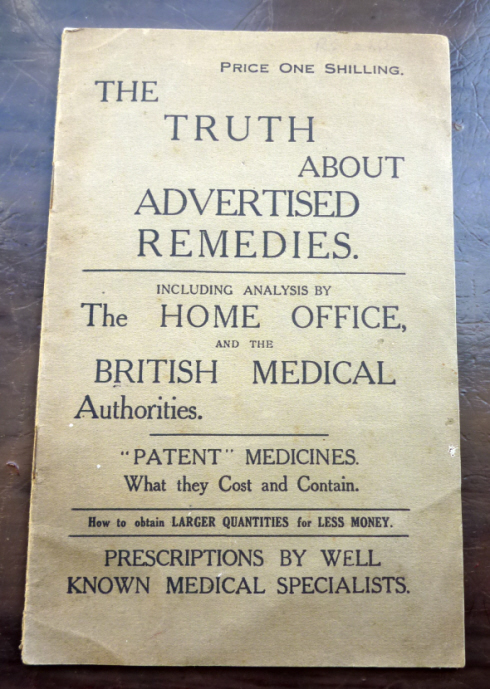
The Truth About Advertised RemediesThis 20-page booklet from about 1927 appears at first glance to be an official publication intended to raise public awareness of the ‘preposterous claims concerning so-called “patent” medicines, which are a disgrace to any civilised nation and a bar to human progress.’

The cover’s references to the Home Office and the British medical authorities, together with the phrase ‘What they Cost and Contain’ unmistakably aligns it with the BMA’s famous exposé of secret remedies, but notice the line:

How to obtain LARGER QUANTITIES for LESS MONEY

Could it be there’s something else going on here? Within the booklet, lecturer and physio-therapeutist William T Davison, head of the Advertised Remedies Exposure Campaign, warns the public against ‘the rubbish that is so often advertised as “Cures”.‘ He goes on to list the formulae of numerous patent medicines, mostly famous brands that had stood the test of time – including Beecham’s Pills, Zambuk, Elliman’s Embrocation, Vick’s Vapour Rub and Eno’s Fruit Salt.

Davison is not out to condemn these products as useless. He acknowledges that many of them are popular because people feel they actually work. The Advertised Remedies Exposure Campaign’s problem with them is not their ingredients but the fact that they are sold at inflated prices. If only someone would help customers out by supplying generic versions at a bargain price…

Well, happily for the patent remedy purchaser, William T Davison was a pharmacist who could do exactly that! Each remedy in the booklet is given a corresponding prescription number so that the bargain-hunting client could order a non-branded version by post from Davison’s company, The British Pharmacies, in Thorpe Bay, Essex. The Advertised Remedies Exposure Campaign appears to have been just Davison himself, and the analyses he published were lifted from the BMJ and from the work of Sir William Willcox, senior analyst and medical adviser to the Home Office. The booklet hints at Davison’s career as a public health lecturer, but as the highlight was ‘some years of which I lectured in Hyde Park, London,’ it is possible that he was not on any particularly distinguished speaking circuits.

Advertised Remedies Exposure Campaign - formulae


Some kudos is due to Davison for coming up with an unusual and convincing method of promoting his business – he does appear to feel strongly about the issue of patent medicines, and the service provided by his shop was useful. By publishing the remedies’ formulae, however, he made it easy for the punter to bypass The British Pharmacies and ask any local chemist to make up the required product. Davison’s bankruptcy in 1933 suggests that his promotional idea didn’t quite work out, but it was worth a try.

Don't be gulled

Categories: Books & Pamphlets | Tags: , , | 1 Comment

They’ll never notice

An unusual medical case takes a grisly turn in 1881:


EXTRAORDINARY MEDICAL CASE

A week ago, a man was brought to the hospital at Pesth, where he soon died, from the result of an accident. The usual autopsy took place, when the doctors discovered, to their astonishment, that the internal organs were transposed—heart to the right, liver to the left—a freak of Nature’s? The case was well nigh unique, for although such abnormal dispositions have occurred before the unhappy wretches whom fate thus revolutionised have all died as sickly infants. But here was a healthy man who might have lived on to eighty with “his heart in the wrong place” but for an accident.

Relations of deceased claimed the body for interment. The doctors were au desespoir; their feeling hearts bled at the idea of having to part with such an interesting “subject”—a glorious addition to the hospital museum. We are all weak mortals and open to temptation. Somebody says that every man has his price, and this “transposed” treasure proved more than the price of the doctors’ virtue. So, to please all parties, they retained the anatomical treasure, save the head, which was normal and uninteresting. To the head they fitted the normal and uninteresting body of someone else, and presented these composite remains to deceased’s relations.

The fraud has been discovered, and now “damages” are loudly called for by the injured parties (as if there had not been damage enough already). The affair has gone over from the the doctors to the lawyers, who will doubtless get their “pickings” out of this very cadaverous business.


The Dundee Courier, 3 January 1881

Categories: Strange reports | Tags: , , , , , | 3 Comments

A nameless tramp’s discovery

Hobo Kidney and Bladder Remedy

Deep in the piney woods of Louisiana there grow certain herbs. Clean, fresh, green little herbs they are, redolent with the smell of the pines and of the wholesome earth that has given them birth.

Years ago, a nameless tramp discovered that these little herbs contained a marvelous power to relieve kidney and bladder disorders in the human system…

The poetic history of the Hobo Kidney and Bladder Remedy refrains from explaining exactly how the tramp’s revelation occurred. It is nevertheless a good example of promoting a product through emphasis on natural goodness and purity – an advertising manoeuvre that’s still going strong today. In honour of its down-to-earth origins, the remedy was named for the hapless itinerant fellow who first stumbled across it (although perhaps he would have been more impressed with a share of the profits and for someone to have had the wherewithal to ask his actual name).

Several consignments were seized under the Food and Drugs Act during 1920, and analyses showed that Hobo was 98% water, with plant extracts (probably goosegrass, traditionally reputed to act against kidney and bladder conditions), potassium nitrate, and benzoic and salicylic acids or their salts. There was truth in the assertion that it didn’t contain alcohol or habit-forming drugs, but other claims went beyond the capabilities of the ingredients.

The booklet accompanying the product said that it would bring ‘speedy relief to all the tortures that kidney and bladder problems entailed,’ while the bottle label presented it as a treatment for ‘Bright’s disease, Acute and Chronic Cystitis, Renal and Vesical Pus or Blood in Urine, Incontinence and Retention, Albuminaria and all Ailments caused from Defective (Kidneys and Bladder) Elimination.’

Headaches, backache, dizziness, forgetfulness, weakness and rheumatism would also succumb to the non-existent anonymous tramp’s herbal discovery.

Sources: 

The Bienville Democrat, (Arcadia, LA) 1 July 1920

The Rice Belt Journal. (Welsh, Calcasieu Parish, LA) 8 May 1920

FDA Notice of Judgment. 9493. Misbranding of Hobo Kidney & Bladder Remedy. U. S. v. 48 Bottles of Hobo Kidney & Bladder Remedy.

FDA Notice of Judgment. 11181. Misbranding of Hobo Kidney & Bladder Remedy. U. S. v. 5 Gross and 2 Gross Bottles of Hobo Kidney and Bladder Remedy

Categories: Kidneys, Urinary | Tags: , , , , | Leave a comment