Posts Tagged ‘Georgian’

Angelick Snuff

Thursday, July 15th, 2010

This noble composition was on sale for most of the first half of the 18th century but enjoyed a moment of fame 200 years later when an American news editor stumbled on the advert and found it entertaining enough to fill a space in his paper. Other papers lifted the text and printed it as a curiosity from the funny olden days. If those early 20th-century reporters had gone back in time to Jacob’s Coffee House in 1739, however, they would not have found much spiritual enlightenment. The product name just meant it contained angelica.

Source: The Daily Post, 17 January 1739

Angelick Snuff

The most Noble COMPOSITION in the World, instantly removing all Manner of Disorder of the Head and Brain, easing the most excruciating Pain in a Moment; taking away all Swimming or Giddiness, proceeding from Vapours, or any other Cause; also Drowsiness, Sleepiness, all other Lethargick Effects; perfectly curing Deafness to Admiration, and all Humours or Soreness in the Eyes, wonderfully strengthening them when weak.

It certainly cures Catarrhs or Defluxions of Rheum, and remedies the most grievous Tooth-ach in an Instant; is excellently beneficial in Apoplectick Fits, and Falling Sickness, and assuredly prevents those Distempers; corroborates the Brain, comforts the Nerves, and revives the Spirits.

Its admirable Efficacy in all the above mention’d Cases, has been experienc’d above a thousand Times, and very justly causes it to be esteem’d the most beneficial Snuff in the World, being good for all sorts of Persons: And as most of the above Disorders are sudden, and the Remedy by this most noble Angelick Snuff as speedy, no Family ought to be without it, nor ever will, when they have once used it. Price One Shilling a Paper, with Directions; and is to be had only at Jacob’s Coffee-house against the Angel and Crown Tavern in Broad-street, behind the Royal Exchange.

Share on Facebook

The Poor Man’s Friend

Friday, June 4th, 2010

The Poor Man's Friend

Source: Trewman’s Exeter Flying Post, 20 July 1826

In 2003, the Daily Mail ran a story titled: Beeswax is ‘miracle’ cure. The article referred to an 18th/19th-century ointment called The Poor Man’s Friend, a popular remedy for wounds and skin conditions. The reason it hit the 21st-century press was that its inventor’s original secret recipe had come up for auction.

Giles Laurence Roberts, proprietor of the Poor Man’s Friend, didn’t have a great start in life. Born in April 1766 in Bridport, Dorset, he contracted smallpox when he was nine months old. Although he recovered, he then got rickets and was unable to walk until the age of five.

Young Giles, however, pulled through, and by his early teens had developed a keen interest in medical botany, studying Culpeper and formulating his own herbal medicines. He achieved some local fame as a healer, particularly for cases of fever and ague, and was also fascinated by electricity, conducting experiments with a homemade electrical apparatus. Unable to make it work at first, he persevered and eventually managed to give himself an electric shock.

At 18, he went to work for a mechanic, but his master soon died and Roberts expressed a wish to become an apothecary’s apprentice. His family didn’t approve and he ended up in Bristol working for an optician. Sharing his lodgings was a respectable surgeon called Mr Pitt, who encouraged him in his interest in healing and anatomy.

Back home in 1788, Roberts set up shop as a druggist and, although unqualified, began practising as an apothecary. After six years’ successful business, he travelled to London to study Anatomy and Midwifery, attending lectures at Guy’s and St Thomas’s, and only a year later arrived back in Dorset as a fully licensed surgeon, apothecary and accoucheur. Only one thing was missing – the title ‘Doctor.’

King’s College Aberdeen awarded him a medical degree on 20 April 1797 – this appears to have been arranged by his tutors in London, and he did not have to do any further study or pass exams. Aberdeen was well-known for awarding medical qualifications on receipt of cash, so it’s possible that some money changed hands. Dr Roberts’s background of diligent study, however, made him far more deserving of his new title than many of the ‘Doctors’ featured on this site.

His successors describe his physical appearance as follows:

He was short in stature, being only about five feet high, dark complexion, a beautiful black eye, and in his younger days long black hair falling on his shoulders. In his dress, and appearance generally, he was singular and original, bearing mostly the character of a Quaker or Friend.

He began selling his own branded remedies at the end of the 1790s, starting with the Pilulae Antiscrophulae for scrophula and scorbutic eruptions. The Poor Man’s Friend remained a local product until about 1820 when it got an endorsement from an aristocratic patient and sales took off.

During the 1820s, Roberts began publishing a yearly pamphlet called the The annual mentor; or, Cottager’s companion: comprising concise maxims and golden rules for preserving the mind and body in health, and conducive to wealth, long life, and happiness, a Friend to the Poor, and a Companion for the Rich.

It’s no surprise that this free publication was mainly a plug for the Poor Man’s Friend and the Pilulae Antiscrophulae. At 32 pages, however, it contained a lot of other useful information. Short essays gave advice on health issues such as personal hygiene:

If dirty people cannot be removed as a common nuisance, they ought at least to be avoided as infectious. Superior cleanliness sooner attracts our regard than even finery itself, and often gains esteem where the other fails.

and there were lists of Wholesome Counsellings, including:

He that will not sail until all dangers are over, must never put to sea.
An ass was never cut out for a lap-dog
The wise man even when he holds his tongue says more than the fool when he speaks.
Marriage is a feast where the grace is sometimes better than the dinner.

There were also articles on choosing a wife, on the slovenly practice of burning green wood, on how to escape from a fire, and many more aspects of life. Although on the surface this all sounds tediously didactic, the information was presented in an engaging, accessible way that doesn’t come across as too worthy, and it beats Britain’s Got Commercial Breaks for an evening’s entertainment.

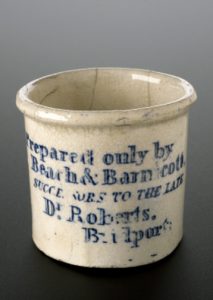
Poor Man's Friend dispensing potRoberts remained in Bridport for the rest of his life, dying in 1834. He left the recipes to Thomas Beach and John Barnicott, who took over the shop – the building is now Grade-II listed and houses a restaurant called Beach & Barnicott.

Roberts was in the middle of compiling the 1835 edition of the Annual Mentor when he died. Beach and Barnicott went ahead with publication, but in a shortened 24-page format. Later editions were reduced to 12 pages, most of which was adverts and testimonials. There were still a few general articles to draw the reader in, but the publication didn’t have the same entertainment value as when Roberts was alive.

The Poor Man’s Friend remained available until the mid-20th century, but made the news in 2003 when Bridport Museum bought the secret recipe for £480. Its composition, in the words of the Daily Mail, was ‘nothing more than 95% lard and beeswax’. Nothing, that is, except the other 5% - a fragrant but dangerous concoction of mercurous chloride, sugar of lead, mercuric oxide, zinc oxide, bismuth oxide, red pigments and oils of rose, bergamot and lavender.

Above right: Mid 19th-century dispensing pot. Photograph courtesy of the Science Museum, London.

Share on Facebook

Cameron the Piss-Prophet

Tuesday, May 4th, 2010

The Anti-Gallican Monitor, 21 May 1815

It is surprising the number of Persons that apply daily from 11 o’clock till 3, at No. 84, Wells-street, Oxford-street, to consult Dr. Cameron, who discovers disorders by an inspection of the morning urine, and although Dr. C.’s method is singular, it it (sic) a well known fact, that he restores many to perfect health, when the most eminent of the profession have failed, in painful, lingering, and dangerous cases; as diseases of the liver, bilious, and other obstructions, complaints in the Stomach, loss of appetite, jaundice, consumptions, dropsy, &c.; also those complaints peculiar to females at the different periods of life, and in all instances of Debility produced by free living and excesses, that derange, disorganize and weaken the nervous and muscular powers.

Source: The Anti-Gallican Monitor, 21 May 1815

————————————————

Uroscopy had been a diagnostic tool for centuries. The colour, consistency, smell and taste of urine were observed since the time of Hippocrates, and in the 17th century Thomas Willis described one circumstance in which it could be useful – in the diagnosis of diabetes mellitus. By Cameron’s time, however, the idea that it was possible to diagnose every disease from the urine alone – often without even seeing the patient – was well within the realms of quackery and uroscopists were derided as ‘piss-prophets’.

Cameron set up as a doctor in Well Street off Oxford Street in about 1809. Initially sharing premises with a silhouette-maker, he soon had enough good fortune to part ways with his impoverished artist friend. Because of urine-casting’s long history, he was able to attract patients who thought there was something in it and who were suspicious of most doctors’ insistence that it was a load of rubbish.

An anecdote in the Medical Adviser (1824) tells of Cameron’s modus operandi. The Adviser is not the most impartial of publications so the details must be taken with a pinch of salt, but they did claim to have verified the story.

A Holborn innkeeper consulted the doctor for chest pains and received some pills. After a month of taking them, he became unable to urinate and, in agony in the middle of the night, had to send for a surgeon to catheterise him. The pills turned out to contain the purgatives jalap and calomel (mercurous chloride), which the surgeon felt had been responsible for his symptoms. He recovered (apart from the chest pain, which was still there) – but not without wanting to pay Cameron back.

The vengeful innkeeper sent his ostler, along with a ‘heavy’ for back-up, to take a urine sample to Cameron. Variations on this story are still doing the rounds today, so you can immediately see what’s coming…

The doctor tasted the urine, and concluded that the sufferer was in a bad way, but could be cured. By asking questions about the age of the patient (24), how hard he worked (lots of heavy loads) and whether he was a drinker (a pail of water twice a day), Cameron diagnosed a bad back, at which point the ostler revealed that the urine was from his donkey.

‘Get out of my house, you rascal!’ bellowed the enraged ‘Doctor’ as he chased the little ostler about the parlour, who now got behind his colossal assistant, and as well might Cameron pierce the shield of Ajax as make an impression upon him, so he contented himself with snatching up the bottle, opening the window and dashing it into the street.

He continued to have a go at the visitors until they ‘coolly retired.’  In reporting the tale, the Medical Adviser certainly didn’t disguise its contempt of the self-styled Water Doctor:

In the name of the north and the honor of old Scotland is this fellow a Cameron? And has the name that is associated with deeds of glory and the might of auld lang syne, dwindled into a filthy water-taster?

Share on Facebook

The tragic story of Ching’s Worm Lozenges

Wednesday, March 17th, 2010


Ching's Worm Lozenges

The Hull Packet, 1 November 1803

..  

What is any self-respecting quack to do in the face of criticism?  

The answer in 1804 was exactly the same as it is now – turn nasty and threaten to sue the arse off everyone.  

The name ‘Ching’s Worm Lozenges’ might suggest that this will be an icky-parasite post, but in a way I wish it were. Instead, this story is incredibly sad.  

There were two kinds of lozenge – yellow and brown – that had to be taken at different times of day. Both contained white panacea of mercury. The travelling sales agents, however, were under strict instructions to assure customers that ‘not a single particle’ of mercury was in them.  

On 4 December 1803, a little boy called Thomas Clayton, aged 3, was given the Lozenges, followed three days later by a repeat dose. He went into a high state of salivation – one of the symptoms of mercury poisoning. His parents sent for medical help, but to no avail.  

.  

…the mouth ulcerated, the Teeth dropped out, the Hands contracted, and a Complaint was made, of a pricking Pain in them and the Feet, the Body became flushed and spotted, and at last Black, Convulsions succeeded, attended with a slight delirium; and a Mortification destroyed the Face, which proceeding to the Brain, put a period (after indescribable Torments) to the life of the little sufferer, on Sunday, the 1st instant, Twenty-Eight Days after he had taken the Poisonous Lozenges.  

The coroner’s verdict was ‘Poisoned by Ching’s Worm Lozenges’ and the above description is from a handbill written by the child’s father, also called Thomas Clayton. Clayton was a printer and bookseller, so was able to produce loads of these leaflets and personally deliver them all around his local neighbourhood in Kingston-upon-Hull. In them, he noted that the main Hull papers (the Packet and the Advertiser) had ignored both the death and the coroner’s verdict – probably because they received so much advertising revenue from Ching’s.  

John Ching himself had died in about 1800. The business was ostensibly carried on by his widow, but really came under the control of a dodgy cove called Mr Butler.  

Signing himself R. Ching, Butler responded with a broadside of his own, attacking the grieving father and threatening to prosecute him for publishing the case. He called Clayton’s words ‘malicious invective,’ ‘AN INFAMOUS ASSERTION and ABOMINABLE FALSEHOOD,’ and said he had ‘FLAGRANTLY LIBELLED TRUTH.’ These handbills were printed by Robert Peck of the Hull Packet – who, like many newspaper printers, was a vendor of patent remedies and was firmly on Butler’s side.  

I don’t know whether Clayton’s grief and campaigning activities led him to neglect his business or whether he was already in financial trouble, but he was declared bankrupt about a month after his son’s death. Although the newspapers hadn’t reported the poisoning, they were quick to advertise the sale of all the Claytons’ property. In a particular act of despicableness, Robert Peck allegedly turned up at the sale and boasted to Mrs Clayton that her husband would not get away with the libel.  

Clayton wanted to take the precaution of getting a written copy of the coroner’s verdict, but when he went to pick it up, he discovered that the coroner ‘had not time’ to do it. The Deputy Town Clerk was equally unhelpful, but it turned out that Butler was all talk and never went ahead with the prosecution.  

By 1805 Clayton must have managed to get back in business as a printer, because he published An Essay on Quackery, and the dreadful consequences arising from taking advertised medicines; with remarks on their Fatal Effects, with an account of a recent death occasioned by a Quack medicine. The author is anonymous and is usually assumed to be Thomas Clayton himself, but I believe it to be his brother, M. J. Clayton. The 140-page essay appears cobbled together, is understandably emotional, and it reproduces lots of excerpts from other writers, but it also offers a measured, sensible list of recommendations for stamping out quackery by replacing the government’s quack-related income with duties on other activities.  

This government revenue was substantial and goes a long way towards explaining why dangerous medicines were allowed to continue. Each bottle or packet had to carry a stamp – some quacks portrayed this as being a mark of official approval but, like most things in life, it was solely a way for the government to get money. I only have figures for 1839, but at that point the government was making approximately £49,300 per year from stamp duty, advertising duty, licences, patents and paper duty (for the wrappers that many remedies were sold in). It’s an awful lot of money, but the price paid by families like the Claytons was much greater.  

In a letter to the Medical Observer, the Essay author is exaggeratedly humble about his literary talents, but hints at attempts to suppress the book, and confesses himself chagrined at the lack of interest from the medical faculty. He also says that his own two children narrowly escaped the same fate as little Thomas, and so the Essay‘s chilling curse on Butler clearly comes from the heart:  

Dire conscience all thy guilty dreams affright,
With the most solemn horrors of the night.
The screams of infants ever fill thy ears,
And injured heav’n be deaf to all thy prayers.  

Share on Facebook

Whitehead’s Essence of Mustard

Friday, March 5th, 2010

Whitehead's Essence of Mustard
WHITEHEAD’S
ESSENCE OF MUSTARD.
—–
CHILBLAINS are prevented from breaking, and their tormenting itching instantly removed, by WHITEHEAD’s ESSENCE of MUSTARD, universally esteemed for its extraordinary efficacy in Rheumatisms, Palsies, Gouty Affections, and Complaints of the Stomach; but where this certain remedy has been unknown or neglected, and the Chilblains have actually suppurated, or broke, Whitehead’s Family Cerate will ease the pain, and very speedily heal them. They are prepared and sold by R. JOHNSTON, Apothecary, 15, Greek-street, Soho, London: the Essence and Pills at 2s. 9d. each;—the Cerate, at 1s. 1½d. They are also sold by the Printer of this Paper, at the HULL PACKET OFFICE, in Scale Lane, Hull, and by every medicine vender in the United Kingdom. The genuine has a black ink stamp, with the name of R. Johnston inserted on it.
The severest Sprains and Bruises are cured by a few applications of the Fluid Essence.

Source: The Hull Packet, 15 April 1806

—————————————————————————————————-

I tend to avoid blogging about the most widely advertised remedies because chances are they’ve already been researched by someone else, and there’s no point in a non-academic, sleep-deprived novelist trying to add anything to the sum of knowledge. So I’ve been skimming over the Whitehead’s Essence ads for ages. They crop up so often in early 19th-century newspapers that I became inured to them – probably much like early 19th-century newspaper readers. I now discover that the product inspired a satire too funny to ignore.

Whitehead’s Essence was patented in 1798, but had been been around for a few years by then. As I’ve mentioned before, one of the conditions of obtaining a patent was that the inventor had to file a specification detailing how to make the product. No one, however, would necessarily test out the recipe, so it was possible to get away with vague or nonsensical instructions. The author of the 1805 publication Essays on Quackery encountered this when he planned to use patents to find out the composition of various remedies. An acquaintance advised him not to bother:  ‘Your recipes on specifications in the patent office will assuredly err, for, although I believe each is given in with the solemnity of an oath, it is doubtful whether any one be true.’

Robert Johnston, owner of the Essence of Mustard, submitted a long and complicated process that would be impossible to replicate without losing the will to live. The Edinburgh Medical and Surgical Journal called it ‘a motley group of ingredients,’ and The Medical Observer asked ‘Does not the grant of a patent for such a most absurd and ridiculous recipe, casts (sic) an indelible disgrace on our country?’ Rather than granting Johnston a patent, they said, the government should have ‘granted a warrant for taking him into custody, and inflicted on him some condign punishment.’

The real recipe was much simpler – oil of turpentine with spirit of rosemary and camphor, plus a small quantity of flour of mustard. Turpentine had long been used as a remedy for chilblains, so there wasn’t much new about this product, but it was famous enough to be known in the US within a few years of being established. And that’s where an amusing parody appeared in March 1798.

The article in Philadelphia’s Weekly Magazine is purportedly a letter from a farrier who has just discovered a wonderful remedy – Blackhead’s Essence of Pitchfork. The writer first condemns the medical profession for charging a fortune for ‘words and wind’:

Apply to a physician—what does he do for you? He feels your pulse; tells you, what you knew before, that you are sick ; takes the fee ; and then packs you off to the apothecary. How long will people be gulled by these men!

He then goes on to introduce the Essence of Pitchfork:

It has been universally acknowledged, that pitchforks are very useful and essential, but rather irritating and inconvenient when taken in their natural state.

The Essence would cure everything, including wooden legs and drowning, and was available in two forms, ‘viz. Sharp, powerful steel points, for internal use, and hickory staff for external’  - a reference to Whitehead’s being available as both a topical preparation and as pills. The article concludes with these testimonials, mocking the whole breed of advertisers who used exaggerated stories to try and sell their remedies:

I DO hereby solemnly declare and affirm, that, as I was walking up Arch-street in January last, I slipped, and tumbled to pieces: By a judicious and timely application of Blackhead’s Essence of Pitchfork, the parts were gathered together, without the loss of a single member.
Jedediah Scarramouch
March 14, 1798

HAVING died some time ago, to the great grief of my dear wife, she applied Blackhead’s Essence of Pitchfork, in staff, to my poor corse. Symptoms of returning life soon appeared, and in a few weeks I was all alive.
Count Obadiah.
March, 1798.

I DO hereby certify, that I used to be as thin and poor as a snake, and was subject to being drowned. I purchased some of Blackhead’s Essence of Pitchfork, and, in due season, grew as fat as a pig, and have never been drowned since.
Joban Nincum.
March, 1798.

Share on Facebook

The Bloom of Ninon

Saturday, February 27th, 2010

The Bloom of Ninon de L'Enclos

DELICACY of Complexion.—The incomparable BLOOM of NINON DE L’ENCLOS, superior to any thing yet discovered for rendering the skin soft, smooth, and beautiful in the extreme. Its wonderful effects in removing freckles, morphews, worms, &c. justly entitle it to that preference so long bestowed on it by the most elegant beauties in this kingdom. It is particularly recommended for the hands and arms, bestowing on them a delicacy and whiteness, superior to any thing vended for similar purposes.—Sold only by Mr. Golding, 42, Cornhill; Mr. Overton, 47, Bond-street; Mr. Wright, Wade’s Passage, Bath; and Miss Grigson, Liverpool; in bottles 4s. each.

Source: The Times, 20 June 1805

——————————————————————————————————————-

The story behind the Bloom suggested it had been introduced to Britain in 1782 by Mademoiselle Louisa Pigout of Paris, who appointed London agents to reach the British market. She credited the product for the beauty of famed 17th-century writer and courtesan Anne (nicknamed Ninon) de L’Enclos, who had handed down the recipe. Another of Pigout’s claims was that the Queen of France, Marie Antoinette, would use no other cosmetic.

A 1784 advert gave detailed instructions for use:

Let the skin be thoroughly cleansed with Almond Washball, or oatmeal. Being wiped perfectly dry, shake the bottle exceeding well, and immediately pour a little of the fluid into a cup, and with a fine cloth rub it on the skin, more or less, as you please, till it is quite absorbed. Lastly, gently wipe the face with a soft flannel. Two or three bottles, and frequently less, will evince the pre-eminence of its virtues, beyond the possibility of a doubt.

Ninon de L'Enclos

If Ninon (right) really employed this preparation, she did well to survive to the age of 84. It comprised almond emulsion, essence of lavender and white lead.

White lead (lead carbonate) had been used in cosmetics since antiquity. In Ninon’s time and well into the 18th century it commonly took the form of ceruse – a mixture of the compound with vinegar. In 1756, Adam Fitz-Adam’s periodical The World noted that women who used ceruse

doe quickly become withered and grey-headed, because this doth so mightily dry up the natural moysture of their flesh: and if any give not credit to my report let them but observe such as have used it, and I doubt not but they will easyly be satisfied.

This was positively complimentary compared with Fitz-Adam’s description of women who used corrosive sublimate, but I’ll keep that for another time. In 1786 a correspondent to the Daily Universal Register (the forerunner of The Times) was equally disapproving of cosmetics in this satirical ‘receipt for making a fashionable lady’:

viz. two pounds of cork, five yards of whalebone, one pound of hair, six pounds of wool or cotton, two drams of white lead, and half a dram of rouge—these, with a proper quantity of bones for the skeleton, and flesh and blood for the muscles, with the skin of a mouse for eye brows, a pound of powder, and half a pound of pomatum, will compleat the business.

The Monthly Gazette of Health – a publication I am very fond of but accept as rather subjective – estimated the cost of ingredients for a bottle of  ‘Bloom’ as 1d, and surmised that it was made in London, not Paris.

‘Bloom of Ninon,’ was the name of a Victorian face powder too, but this was a completely different product, consisting of precipitated chalk, talc, bismuth subcarbonate, zinc oxide and starch, perfumed with orris and rose essences. The use of lead cosmetics, however, continued throughout the 19th century, particularly in the theatre. In the 1850s, a writer in the Medical Times and Gazette described the case of a clown suffering from colic as a result of using lead carbonate mixed in lard. On his recovery he planned to continue using it because nothing else would create the desired whitening effect, but was eventually persuaded to convert to zinc oxide.

Medical jurisprudence writer Alfred S. Taylor described the symptoms of chronic lead poisoning as follows:

There is first pain, with a sense of sinking commonly in or about the region of the umbilicus. Next to pain there is obstinate constipation, retraction of the abdominal parietes, loss of appetite, thirst, foetid odour of the breath, and general emaciation. The skin acquires a yellowish or earthy colour, and the patient experiences a saccharine, styptic, or astringent taste in the mouth. A symptom of a peculiar nature has been pointed out by the late Dr. Burton and others (Med. Gaz. xxv. 687), namely, blueness of the edges of the gums, where these join the bodies of the teeth : the teeth are of a brownish colour.

Although the idea of historical ladies sacrificing their lives to vanity makes a good story, confirmed cases of death by cosmetics were few and far between. Reported instances of lead poisoning usually involved accidental ingestion via contaminated foodstuffs or water, or prolonged exposure to lead in the trades of house-painting and colour grinding – the symptoms of chronic poisoning were commonly known as painter’s colic.

Even so, it was not a great idea to put lead on your face. As the Monthly Gazette said of the Bloom of Ninon in 1819:

The repeated application of lead to the skin of the face, instead of animating the countenance, would assuredly, by paralysing the nerves, render it inanimate.

Therefore, it was nothing like any beauty treatments that are available today.

Share on Facebook

Lardner’s Prepared Charcoal for the Teeth

Tuesday, February 9th, 2010

Lardner's Prepared CharcoalFOR Beautifying and Preserving the TEETH.—LARDNER’s superior prepared CHARCOAL, so much recommended by the Faculty for its safe and antiseptic properties, for cleaning, preserving, and making the teeth beautifully white, in boxes at 2s. and 2s. 9d. each; and Mouth Solution, for curing the scurvy, bracing the gums, preventing the tooth ach, and unpleasant breath, in bottles at 2s. 9d. and 5s. 6d. each. From the great reputation the above preparations have acquired, many imitations are daily offered for sale: the true only are signed “Edmund Lardner” on the label. It is sold wholesale and retail, corner of Albany, Piccadilly; and retail by Newbery, St. Paul’s Church-yard; Rigge, Cheapside; Vade, Cornhill; Davison and Son, Fleet-street; Bacon, Oxford-street; Bailey and Blew, Cockspur-street; and most venders of genuine medicines.

Source: The Times, 22 February 1809

———————————————————————————————————————-

Nowadays we know that to discover the secret of teeth-whitening, you have to be a single mum, but at the turn of the 19th century it was an ordinary chemist, Edmund Lardner, who introduced this new dentifrice to the public.

Charcoal had long been known as a tooth-whitener, but more so in the East than in this country, and Lardner’s attempts to encourage British people to use it met with approval from physicians.

In 1805 his company published a 3-page pamphlet extolling charcoal’s virtues.

It possesses the desirable qualities of rendering the teeth beautifully white; destroying the fætor arising from carious teeth, which contaminates the breath; removing the scurvy from the gums, and stopping the progress of the decay of the teeth, while, at the same time, it is incapable of either chemically or mechanically injuring the enamel.

A year later, one of Lardner’s shopmen, Alexander Blake, left the company and began selling his own version of the tooth powder, still using Lardner’s name. Lardner claimed to have improved the original product and also upped his competitive game by introducing a new Concentrated Solution of Charcoal.

His enthusiastic promotion of charcoal for the teeth was perfectly acceptable. The only odd thing was that his products didn’t actually contain much of it. The Prepared Charcoal was mainly powdered chalk, with a small amount of genuine charcoal or ivory black (a pigment made from charred animal bones) to darken it. The Concentrated Solution was a spirituous infusion of roses and myrrh, and was later renamed the Mouth Solution. The Medical Observer, while broadly sympathetic to Lardner as a reputable druggist, commented

In what respect roses and myrrh resemble charcoal, we know not,

while The London Medical and Surgical Spectator saw nothing wrong with the solution itself but objected to the false name.

The products remained popular and were used by Lord Byron, who asked his friend Douglas Kinnaird to send him a supply while he was in Venice in 1818. Activated charcoal is still known today as a tooth whitener and odour neutraliser, and Korean and Japanese companies have recently introduced it in a fascinatingly unappealing toothpaste form.

Korean Charcoal Toothpaste

Share on Facebook

The Pure Drops of Life

Monday, January 18th, 2010

Pure Drops of Life

Source: The Morning Chronicle, 27 August 1803

THE PURE DROPS of LIFE; or, Vegetable Extract, prepared only by T. M. Lucas, V.D.M. Road, near Bath. Sold, by special appointment, at Messrs. H. and W. Humphries, No. 87, Fleet-street; No. 2, Haymarket; Mr. G. Long, No. 13, Great Newport street, Long Acre; Mr. Tabart, 157, New Bond -street; Mr. Palley, Newington Causeway; Mr. Leathwait, Royal Exchange; and by the principal Venders of genuine Medicines in the United Kingdoms; in Bottles at 2s. 9d. 6s. 11s. and 22s. each.—N.B. There is a saving of 1s. on the 11s. and 5s. on the 22s. Bottles
REV. CHARLES GREENLY, TO MR. LUCAS.
James’s-street, Bath, May 4th 1800
Sir—For several months I have been much afflicted with a very great hoarseness; I tried several things for relief, but to no purpose; at last I was prevailed upon to take your Pure Drops of Life; I soon found relief, and I bless God, after taking a few bottles, my hoarseness was entirely removed. I believe your drops to be a very precious cordial. I have recommended them to several, and shall continue to recommend them, and am your affectionate                                                                                                                       CHARLES GREENLY.

………………………………………………………………………….

Hoarseness was just one complaint that would supposedly surrender to the Pure Drops of Life. Mr Lucas also advertised them as being efficacious against colds, coughs, liver complaints, cholera morbus (this term could apply to a variety of gastrointestinal afflictions), palpitations, nervous affections, incubus (nightmares), and ‘indispositions of females’. He recommended them to singers and public speakers, saying ‘this Discovery is the greatest ever known, for clearing the voice, strengthening the lungs, and animating the whole frame.’

The ingredients included ‘a great variety of Flowers, Fruits, Seeds, &c.,’ so an endorsement from über-botanist Sir Joseph Banks was just the thing to give the Drops credibility. In a promotional pamphlet, Lucas claimed that he had visited Sir Joseph, who had taken a glass of the remedy and pronounced it an excellent carminative (anti-fart medicine). From this, Lucas concluded that:

If the pure drops of life are approved by the first botanist in the world, what family would be without them?

The key word is, of course, ‘if’. In 1807, a new anti-quackery publication called The Medical Observer wrote to Sir Joseph (after some prompting from a reader) for his version of events. He replied:

I am much too well convinced of the unavoidable necessity of regular medical advice, in the administration of every medicine whatever, to have on any occasion allowed my name to be used as a recommendation of any nostrums or quack medicines.

He had never seen Mr Lucas’s advertisements and the use of his name was unauthorised. The wording doesn’t rule out the possibility that Mr Lucas did encounter Sir Joseph at some point, with the two parties perhaps interpreting the meeting differently, but  Sir Joseph’s view was:

I certainly consider it a crime against the public, to recommend to them, by false pretences, or by deceit of any kind, medicines or any other matters or things.

The Medical Observer also drew attention to the letters V.D.M. after Lucas’s name – a suffix that might have appeared to the unwary to be a medical qualification, but meant Verbi Dei Minister – Minister of the Divine Word. This was a fairly flexible designation that people could adopt to show their dedication to preaching the Gospel, without necessarily having a theology degree or being ordained in the Church of England. It was useful for nonconformist preachers who had a strong commitment to God but nothing much ‘official’ to back it up (er… a bit like how I claim to be a historian just because I research history a lot, I suppose!)

Some of Lucas’s ads refer the reader to an article in the Evangelical Magazine that supported his claims. In fact, this was just another advert that he wrote himself. I don’t know whether Lucas was a genuine preacher but I suspect he was, and probably didn’t see any contradiction between his calling and his rather dubious methods of promoting his invention.

The Medical Observer mentions the wider problem of quacks using fake or irrelevant qualifications to impress the punters. It tells of one such character who, as well as claiming to be an M.D., put E.D.   A.T.W.   D.A.  after his name. Although I wouldn’t put it past the editors to have embellished this story, it’s worth repeating what the letters stood for:
E.D. – Electrical Doctor
A.T.W. – Author of a Treatise on Worms
D.A. – Donor of Advice

There – I think everyone on the planet qualifies as a D.A. Congratulations!

.

Share on Facebook

The Famous Montpellier Venereal Little Bolus

Wednesday, January 13th, 2010

Montpellier Venereal Bolus

Source: The General Advertiser, 6 March 1744. Click here for transcript.

I wonder if this advert looks familiar to regular readers. The writing style and capitalisation, and even the medicine’s name, are reminiscent of Mr. Burchell’s Famous Little Sugar Plums, and here again we see a proprietor tempting punters with freebies. Dr Russel of the Green Hatch, Holborn, sought to tap into Burchell’s success by adopting the same tactics, but over the years it isn’t a clear-cut case of him copying his contemporary – they used lots of similar ploys and it’s not always obvious who got there first.

Ads for The Montpellier Little Bolus and Burchell’s ads for his Anodyne Necklace appear in the same papers, sometimes right next to each other. As I mentioned in the Sugar Plums post, Burchell gave away free almanacks – so did Russel, whose publication was called the Thee and Thou Almanack. The adverts say it offered answers to common questions about Quakers:

Why we are called QUAKERS?
Why we’ve Silent Meetings? Why Women Preach as well as Men?
Why we use THEE and THOU? Why we never Put off our Hats?

Russel also resorted to poetry:

This ALMANACK has Nothing Writ twice o’er
What’s in’t, No ALMANACK e’er had Before :
It is quite NEW, Year Thirty-EIGHT its Date is,
‘Twill Nothing Cost, for Thee may’st have it GRATIS,
At the Green Hatch, ‘gainst Gray’s Inn Gate in Holborn,
If to ASK for’t, Thee will not be too Stubborn.

(both bits quoted from the London Daily Advertiser, Feb 4 1737)

My favourite aspect of the ad at the top is that it offers a free dose to anyone whose name appears in the Venereal and Gleet Patient’s Directory.

‘Gleet’ (the word derives from the Middle English for slimy, and is related to the Latin gluten, meaning glue) refers in this context to a mucopurulent discharge from the urethra or vagina as a result of gonorrhoea. It lingered after the acute symptoms had subsided, and although clearly the result of the clap, was viewed as a condition in its own right. It is described as follows by William Buchan:

…when the quantity of running is considerably lessened, without any pain or swelling in the groin or testicle supervening; when the patient is free from involuntary erections; and lastly, when the running becomes pale, whitish, thick, void of ill smell, and tenacious or ropy ; when all or most of these symptoms appear, the gonorrhoea is arrived at its last stage, and we may gradually proceed to treat it as a gleet with astringent and agglutinating medicines.

Such astringent medicines included white vitriol (zinc sulphate) and preparations of lead injected up the affected parts. The great John Hunter wasn’t overly enthusiastic about astringents – he advised that introducing a simple, unmedicated bougie (a slender instrument) into the urethra would be enough to cure most gleets (in men, that is – he dismisses women’s gleets in a couple of paragraphs). The bougie ‘need only be five or six inches long‘ and required ‘a month or six weeks application.’ Hunter also mentions gleets cured by electricity, but does not specify how the cure was carried out.

For people putting up with this nagging condition, and faced with a variety of embarrassing and eye-watering cures, quack pills were worth a try, but the real genius of Russel’s modus operandi lies in the free pamphlet. The mid-18th-century sufferer was not expected to be loyal to a specific doctor and to blindly accept whatever he advised, so the average individual with a gleet might well have done the rounds of several practitioners and nostrum vendors. The idea that somewhere along the way you’d got on a published list of venereal patients was rather alarming.

Whether Russel’s directory contained real names or made-up ones, I don’t know, but once people arrived at the Green Hatch for a furtive shuffle through the pages, they were a captive audience for the Montpellier Little Bolus at 2s. a pop.

Share on Facebook

A Poem on Christmas Day

Friday, December 25th, 2009

From the Gentleman’s Magazine, December 1766:

CHRISTMAS DAY.

Welcome, thrice welcome Christmas day !
Let’s eat, drink, dance, and sing away:
Old England ne’er had stronger reason
To welcome in this joyful season !
Mark high and low, and all around us
And know the blessings that surround us.
Let ‘em in all their pomp appear;
Sure omens of a happy year !
First, turn your eyes upon the great ;
When did such virtues rule the state ?
The country has their whole attention,
Without a thought of place or pension.
Of parts, and pow’r, no prostitution,
Of liberty, no diminution ;
Sound as a roach our constitution
Which florid grown, by over feeding,
Is now quite cool with frequent bleeding :
Great Lawyers, with our good at heart,
Now every day new doctrines start.
For freedom and for Magna Chart,
Our clergy too, all int’rest scorning,
Are teaching, preaching, night and morning ;
T o keep their flocks secure at home,
And guard them from the wolves of Rome:
So by their zeal, which never ceases.
The growth of popery decreases.
Physicians now cure each disease,
They take great pains, and little fees.
Nothing but learning, parts, and knowledge,
Can give a passport to the college :
No poison’s sold for nerves or vapours,
No quacking nostrums fill the papers—
These are the gifts the great have sent ye,
For all is concord, peace, and plenty.
The poor, as fat as brawn, we meet ,
Eating minc’d pyes along the street
No Harlots to be seen, not one,
Not ev’n the Whore of Babylon !
These times are sung by great and small
‘Tis merry Christmas for us all;
And certain ’tis, by what is past,
That the new year will match the last.

Share on Facebook