Posts Tagged ‘narcotics’

Habitina – an infallible remedy for addiction

Thursday, June 24th, 2010

Habitina advert from the Fort Wayne Journal Source: The Fort Wayne Journal-Gazette,17 April 1907

——————————————————————————————

Following on from the last post, we remain in early 20th-century America. But while Mayr’s Wonderful Stomach Remedy was fairly harmless (albeit rather revolting), this nostrum was notorious for the damage it caused in just 6 years of existence. Between 1906 and 1912, the Delta Chemical Company made more than half a million dollars by supplying morphine addicts with its own branded version of the narcotic.

The company was run by Dr Robert Prewitt and Ryland C. Bruce. Prewitt’s medical qualification was genuine, but he never had much success as a practising physician, trying his hand at surgical instrument selling in Little Rock, AR, until this venture went down the pan. He then became a travelling salesman for various chemical companies and ended up working at a St Louis sanatorium that ran a mail-order addiction cure business on the side.

Prewitt, in partnership with former insurance salesman Bruce, took over this business in 1906 and started to think big. They traded as the Delta Chemical Company and dubbed their product Morphina-Cura, an ‘infallible remedy’ for drug habits of all kinds.

1906 ad for Morphina-Cura

The product name changed to Habitina in 1907, probably because titling something a ‘cure’ could lead to allegations of misbranding under the Pure Food and Drug Act. Addicts – then often referred to as habitués – were advised to ‘discontinue the use of all narcotic drugs and take sufficient HABITINA to support the system without any of the old drug.’ They should then gradually decrease the dose until they stopped taking it altogether.

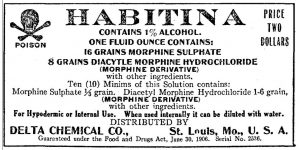
This was in line with reputable medical practice, but for addicted patients with no supervision, life didn’t work out according to the instructions. Habitina contained 16 grains (approx 1g) of morphine sulphate and 8 grains of heroin per fl. oz. It was simply a more expensive way of continuing to take huge hits of narcotics – and of course the money went straight into Prewitt and Bruce’s pockets. The company hooked people in with free samples, and although they claimed to make patients answer a questionnaire, in reality they would send the freebies out to anyone who asked.

In 1912, Prewitt officially changed his name to Gregg because of his wife’s father’s will. Old man Gregg stipulated that his daughter must keep her maiden name or forfeit her inheritance of $50,000. Her first husband had gone along with it without changing his own name, but romantic Prewitt decided to be at one with his spouse, and the couple became Dr and Mrs Robert Prewitt Gregg.

Just a few months later, however, Prewitt’s fortunes changed. He and Ryland Bruce were arrested and charged with sending poison through the mail and with using the mail for a scheme to defraud. The trial revealed the devastating effect of Habitina on its victims, several of whom testified in court.

Some had experienced periods of insanity – Missouri mechanic Mr. H. I. C. lost everything and became a ‘maniac’ consuming a whole $2 bottle of Habitina every day. Mrs M. P. of Pennsylvania lost her reason and went blind as a result of taking the medicine, but hospital treatment eventually cured her addiction.

Perhaps the most tragic case is 26-year-old Mrs G. M. S., who spent more than $2,300 on Habitina over the course of 5 years, even going without shoes to be able to afford it. At the time of the trial she was still addicted.

Prewitt and Bruce were found guilty on both counts, fined $2000 each and sentenced to five years’ hard labour. It would be nice to end on that note, but the pair appealed. At the appeal court, Judge Munger dismissed the count of sending poison through the mail, as registered physicians were still permitted to do this, and sent the second count – the scheme to defraud – to a new trial.

At this point, I must own up to an epic fail, because I haven’t been able to find out anything about the second trial – if anyone can point me towards any sources, I’d be grateful. I imagine Prewitt and Bruce were acquitted because being unscrupulous doesn’t necessarily amount to a crime. They were careful to remain within the law as regards labelling their product, and made it very clear that Habitina contained morphine and that a cure would only result from a gradual reduction in dose.

They surely knew that they would make a fortune from addicts who would take it willy-nilly for years, but even with my lack of legal knowledge, I suspect this couldn’t technically be defined as a scheme to defraud. As you can see from the bottle label, they weren’t exactly misleading people about what was in it:

Habitina label

Tucker’s Asthma Specific

Saturday, March 27th, 2010

For me, growing up in the 1980s, asthma was a convenient way of getting out of P.E. I can imagine, however, how disabling the condition must have been before modern drugs like salbutamol. Anything that claimed to relieve asthma would have been worth trying – but Dr Tucker’s remedy carried with it the danger of addiction.

Tucker's Asthma Specific

Pall Mall Gazette, 10 March 1900

This advert for Tucker’s Asthma Specific is fairly unassuming compared with the big pictorial ads in fashion at the time, but it was well-positioned on the front page of London’s Pall Mall Gazette. The product originated in Mount Gilead, Ohio, where Dr Nathan Tucker started The Asthma Specific Company in 1889. (The title ‘Dr’ was genuine.)

Early 20th-century analyses had varying results, but most agreed that the Specific contained cocaine and atropine. While the company emphasised that the amount of cocaine in each inhalation was tiny, the Journal of the American Medical Association didn’t approve:

When one considers the prevalence of the cocain habit and demoralizing and brutalizing effect that this habit has on its victims, the viciousness of the indiscriminate sale of a preparation of this sort becomes evident.

They were particularly concerned about the method of taking the medicine – it was vaporised and inhaled into the nose:

It is only necessary to call attention to those cocain habitués, known as “coke-sniffers” to realise the enormous harm that can be done by the taking of cocain in this way.

An inhaler plus an initial supply of the liquid cost $12.50 in the US and 3 guineas in Britain and you can see Nathan Tucker demonstrating the inhaler below. The company operated by mail order – punters had to fill in a questionnaire and would receive a diagnosis and prescription by post. This was a marginally better bet for American patients than British ones – at least Nathan Tucker and his nephew William Briscoe Robinson were qualified doctors. In the UK, the business was run by Tucker’s brother, Augustus Quackenbush Tucker (no, seriously!) who had no medical qualifications and later claimed he didn’t even know what was in the medicine.

Nathan Tucker demonstrates the asthma inhale

There were thousands of happy customers, but for some the outcome wasn’t much fun.

In 1908 the Specific was implicated in the death of a British patient – 36-year-old Margaret Weston from Slough. She had been using the inhaler for two years and the doctor who attended just before her death noted symptoms of cocaine poisoning. The American Medical Association, in Nostrums and Quackery, implied that the Specific killed her, but in their quack-busting enthusiasm, didn’t mention that the inquest found she had also had a cocaine injection for dental work. At about the same time, Augustus Tucker was fined £5 plus £5 5s costs for selling the preparation without marking it ‘Poison’, and for not including an address on the packaging.

Nathan Tucker retired in 1910 and William Robinson took over the business, but got into trouble five years later when a court ruled that under the Harrison Narcotic Act, it was illegal for the company to prescribe its product by mail. Robinson somehow managed to get round this and continued the mail-order system, with his son Dr Gerard Briscoe Robinson later joining him. Tucker’s Asthma Specific was around until 1959, when G B Robinson died in a plane crash and the company’s assets were sold off.