Image credit: Getty Research Institute.
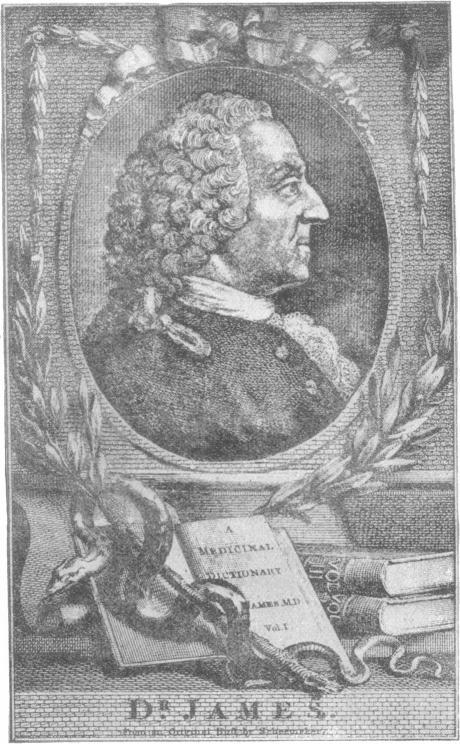
Dr Robert James (1703-1776) was an uncouth, hard-drinking, verbose buddy of Samuel Johnson – but amid the carousing and lexicography, he found time to create one of the most prominent patent medicines of Georgian England.
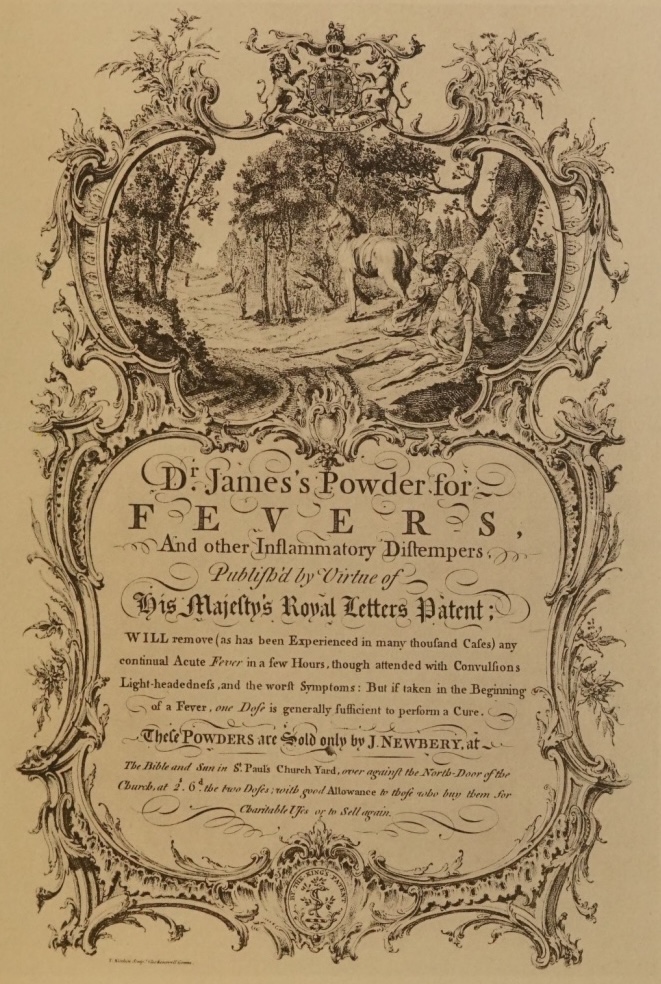
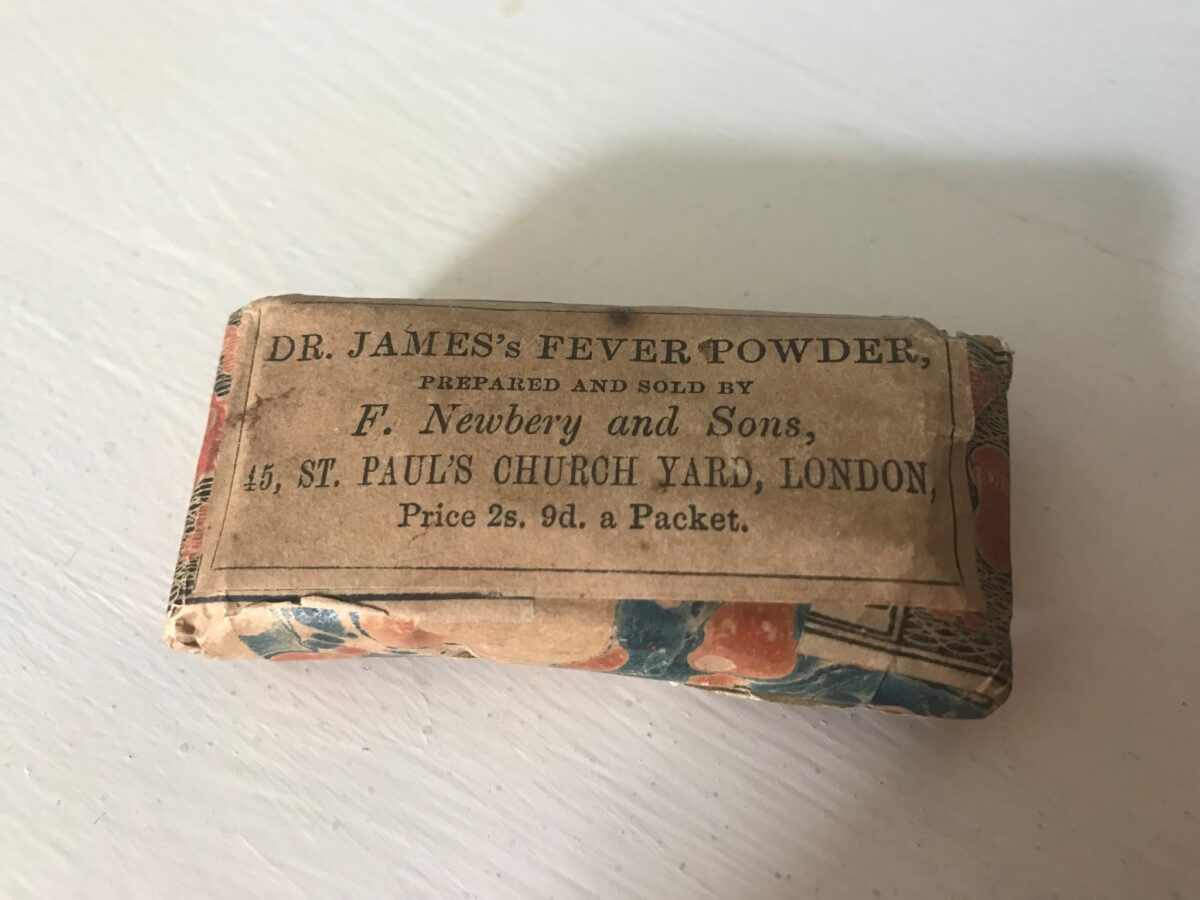
Dr James’s Fever Powder became the go-to treatment for a list of inflammatory disorders including agues, erysipelas, smallpox and childbed fever, as well as everyday complaints such as coughs and colds.
The term ‘patent medicine’ has historically been used as a generic name for any branded remedy – indeed, that’s exactly how this website employs the term. In practice, however, many proprietors preferred not to apply for a patent due to the fact that you had to give a specification detailing the ingredients and method of making the product. This risked either revealing that there was nothing special about your medicine, or giving competitors the means to replicate it.
Robert James, however, did receive a patent for the Fever Powder in 1747, and maintained the secrecy of his formula by giving an obscure and probably false specification.
James hailed from from Kinvaston in Staffordshire and attended Lichfield Grammar School at the same time as Samuel Johnson, with whom he remained friends.
James gained a Bachelor of Arts degree from St John’s College, Oxford; he subsequently studied medicine and became an extra-licentiate of the the Royal College of Physicians of London. (Extra-licentiate meant he practised outside the city, whereas a licentiate would be within London.) James received a Cambridge medical degree in 1728 by royal mandate. He practised in Sheffield, Lichfield and Birmingham before moving to London, and also wrote extensively on medical topics.
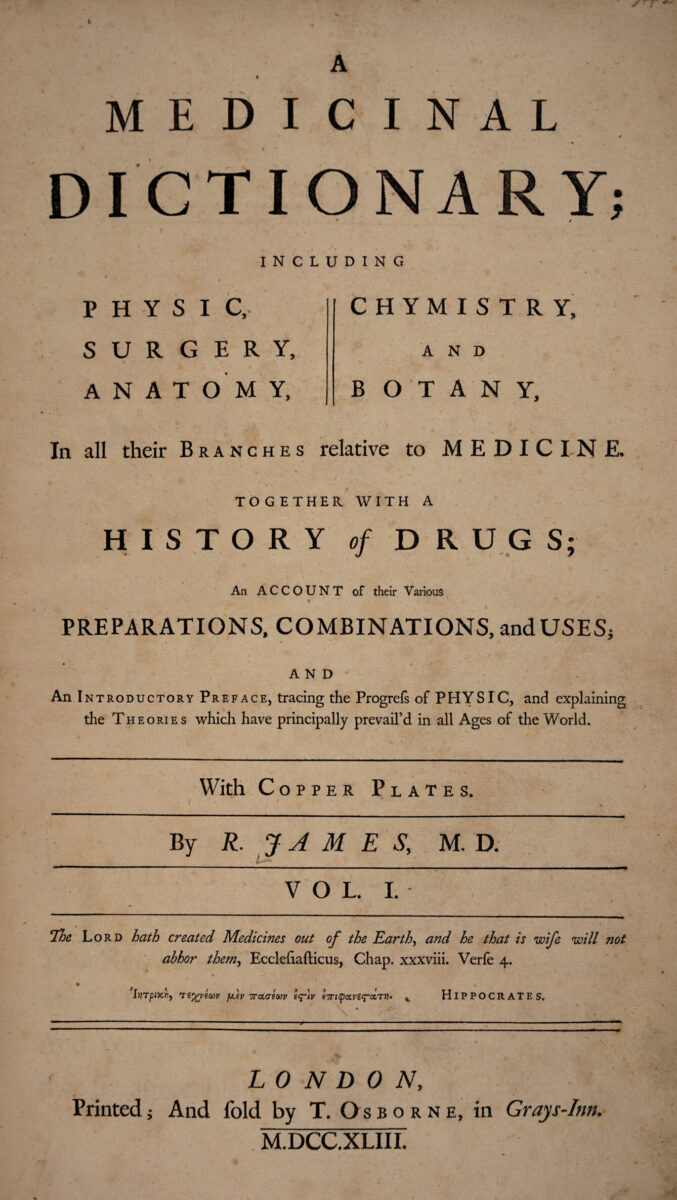
His most famous work was his 1743-45 A Medicinal Dictionary, Including Physic, Surgery, Anatomy, Chymistry, and Botany, in All Their Branches Relative to Medicine – a huge three-volume set for which the preface alone comprised 99 pages of dense and rather tedious text. Lichfield Grammar was evidently a hothouse for lexicographers, and Johnson contributed some of the entries for his friend’s magnum opus.
James also wrote treatises on Gout and Rheumatism and on Canine Madness (rabies) as well as a Dissertation on Fevers and Inflammatory Distempers, to which was later appended a Vindication of the Fever Powder. This final work – written in response to what his editor called ‘the violent and calumnious attacks of his brethren of the faculty’ remained unfinished at his death.
Some enlightening information about James’s character comes from Chalmers’ General Biographical Dictionary (1803), which describes him as: ‘rough in his manners, and, if not very generally misrepresented, far from temperate in his habits.’ He was prone to confusing patients’ pulses with his own and, ‘finding that one was quickened by intemperance, to have bluntly accused the patient, perhaps a delicate lady, of being in liquor.’ Physically, the drink seems to have taken its toll: ‘His person had not more delicacy than his manners, being large and gross.’
In 1771 , Dr James Lind (of citrus-for-scurvy fame) reported the results of a trial of the fever powder at the Haslar naval hospital in Gosport. Around 1000 patients received it, starting in small doses and increasing if the patient coped well. Some positive results occurred, especially in those with violent head pains, but Lind interpreted this cautiously. He noted that the patients also received the usual treatments of bloodletting and blistering, which might have helped them anyway.
He decided the powders weren’t a useful medicine because, unless the practitioner knew what was in them, he couldn’t safely prescribe them. While the real formula remained a secret, they were best avoided.
‘The promiscuous use of this powder, in the hands of the ignorant, and of quacks,’ Lind wrote, ‘will render it doubtful whether such a remedy would do most good or harm.’
‘Fever’ is, of course, a broad term, but Robert James argued that it was not necessary to know the exact nature of the disease in order to treat it. His medicine could be effective for many inflammatory conditions:
‘There are many ways of lighting a candle, by a piece of paper, by charcoal, by pit-coal, or by a brimstone match; but in every case an extinguisher will put it out, without paying any regard to the remote or immediate cause of its burning.’
Dr James’s Fever Powder remained a popular product long after its inventor’s death, under the aegis of reputable medicine wholesaler Francis Newbery of St Paul’s Churchyard, London. James had gvien Newbery’s father John, a prominent bookseller, a financial interest in the product right from the beginning.
The Powder was still available in the 1860s – and a rival product sold by someone purporting to be James’s grandson continued through the 1870s – but in the last decades of the 19th century it was mostly remembered as a throwback to a bygone era.
What was in Dr James’s Fever Powder?
In his 1747 patent, Robert James described the process of making the powder as follows:
Take antimony, calcine it with a continuous, long protracted heat in a flat unglazed earthen vessel, adding to from time to time a sufficient quantity of any animal oyl and salt well dephlegmated; then boil it in melted nitre for a considerable time and seperate (sic) the powder from the nitre by dissolving it in water.
However, attempts to replicate this proved difficult. In 1791, chemist George Pearson carried out extensive experiments and concluded that the powder was principally antimony oxide with calcium phosphate. A similar generic preparation, pulvis antimonialis, was part of the London Pharmacopoeia from 1787.
The toxicity of the antimony resulted in vomiting, diarrhoea and profuse sweating, thought to flush the disease out of the system. However, it was also dangerous, and the powders have famously been implicated in the death of the writer Oliver Goldsmith. It is also possible that they contributed to the demise of Irish courtesan Peg Plunkett, who, already weakened by mercury treatment for venereal disease, took the powders for a fever during her final weeks in 1797.
Sources:
James Lind, An Essay on Diseases Incidental to Europeans in Hot Climates, London, 1771.
Alexander Chalmers, The General Biographical Dictionary. 32 volumes. London: J. Nichols and Son, 1812-1817. Vol 18.
William Hawes, An Account of the late Dr Goldsmith’s Illness, so far as relates to the exhibition of Dr James’s Powders, London, 1774.
Specification of Robert James : fever powder and pill, London : Great Seal Patent Office, 1747.
Stephen, Sir Leslie, ed. Dictionary of National Biography, Volumes 1–22, Oxford University Press, 1921–1922.
George Pearson, F.R.S, ‘Experiments and observations to investigate the composition of James’s Powder’, Philosophical Transactions of the Royal Society (1791) (81): 317–367.
Peg Plunkett, The Memoirs of Mrs Margaret Leeson, Dublin, 1797.